
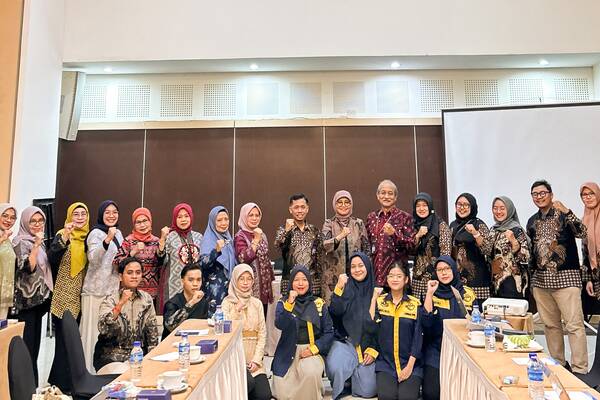
*YOGYAKARTA* – Preventing violence in higher education depends on strong governance, clear regulations, institutional capacity, and the competence of the people who protect the academic community. To ensure an integrated prevention system, the government encourages every campus to establish a Violence Prevention and Handling Task Force (Satgas PPK).
Hasanuddin University has built a violence prevention system since 2022. Initially, the task force focused on the Prevention and Handling of Sexual Violence (PPKS). In March 2025, the unit was renamed the Satgas PPK, with a broader mandate to make the campus a safe space free from all forms of violence.
To improve capacity and competence in innovative ways of handling violence on campus, the Unhas Satgas PPK made a working visit to Yogyakarta State University (UNY). The visit was used to hold discussions with the UNY Satgas PPK in order to share good practices in implementing violence prevention and handling systems.
Unhas Vice Rector for Human Resources, Talent Development, and Welfare, who is also Chair of the Satgas PPK, Prof. Dr. Farida Patittingi, S.H., M.Hum., said the meeting was an opportunity to evaluate good practices already under way while identifying new approaches that can be applied according to institutional needs.
“The synergy between Unhas and UNY continues to grow through institutional strengthening, human resource capacity building, and the drafting of policies that side with victims while still putting prevention first,” Prof. Farida said.
In line with this, UNY Vice Rector for Human Resources and Legal Affairs Prof. Dr. Siswanto, M.Pd., said that a safe academic environment is a prerequisite for optimal education. Every university needs to build a culture of mutual respect through continuous education and the involvement of all campus elements.
“Cooperation between campuses is a strategic step in building a higher education ecosystem free from all forms of violence,” Prof. Siswanto said.
UNY Satgas PPK Chair Dr. Anang Priyanto, S.H., M.Hum., said that networks among task forces speed up learning between institutions. The experiences shared by each university serve as references for refining prevention education, victim assistance services, competency building for task force members, and the drafting of standard operating procedures that are relevant to developments in the higher education environment.
The meeting resulted in a commitment to strengthen communication, expand the exchange of good practices, and develop collaboration in implementing policies for the prevention and handling of violence. This step is expected to strengthen universities’ capacity to create learning spaces that are safe, inclusive, and uphold the dignity of every member of the academic community.
The meeting between the two parties took place on Friday (7 August) at Yogyakarta State University. Task force members from both universities attended. (*/aks/mir)
Editor : Ishaq Rahman
This article is an English translation of the original Indonesian report.