
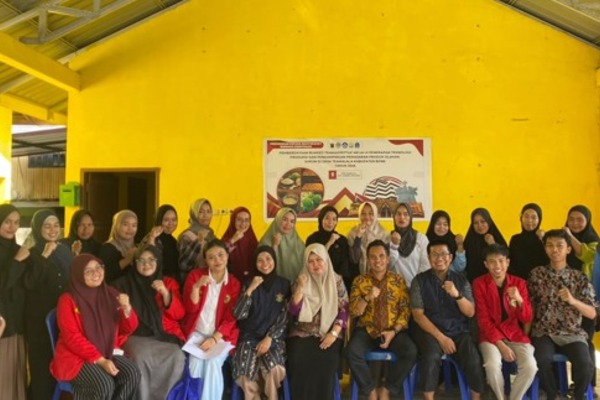
BONE – Breadfruit has mostly been marketed fresh, with a relatively short shelf life. As a result, its economic potential has not been fully tapped. Through the application of food processing technology, Hasanuddin University (Unhas) is working to turn this seasonal commodity into an industrial raw material with higher added value.
This commitment took the form of training in breadfruit flour processing technology for workers of the Temmapettue Village-Owned Enterprise (BUMDes) and residents of Tea Malala Village, Bone Regency. The community service program, funded by the Ministry of Higher Education, Science, and Technology (Kemendikti Saintek), focuses on standardizing the production process so that the breadfruit flour has consistent quality and is ready to compete in a wider market.
The training was opened by the Tea Malala village head, Andi Syamsu Alam, S.Pd., M.Pd. In the opening remarks, the village head expressed full support for developing the breadfruit flour business run by BUMDes Temmapettue. Applying production technology can strengthen the BUMDes’s capacity so that it can produce high-quality products with clear standards and improve community welfare.
“We hope breadfruit flour can become one of the village’s flagship products that brings economic benefits to the community,” said Andi Syamsu Alam.
The chair of the Tea Malala Village Family Welfare Empowerment (PKK) Mobilization Team, who is also the manager of BUMDes Temmapettue, Fitriani, Amd.Keb., explained that breadfruit flour has been produced until now, but product quality has not been uniform because there has been no standard process. This training can help the BUMDes produce breadfruit flour of more stable quality, making it easier to meet market demand and open wider marketing opportunities.
The leader of the Unhas community service team, Dr. Muhammad Asfar, S.TP., M.Si., explained that besides introducing new technology, the activity also builds a sustainable business ecosystem based on local resources. Breadfruit has a high starch content, so it has the potential to become a raw material for a variety of food products. The main challenge so far has been the fruit’s short shelf life, so processing technology is needed to maintain quality while increasing its economic value.
“We want to change how people view breadfruit. It should not only be sold fresh during harvest season, but processed into flour that has a longer shelf life and better quality and can serve as a raw material for various value-added food products,” said Dr. Asfar.
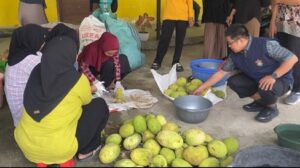
In the training, participants learned and practiced every stage of breadfruit flour production, from sorting raw materials, peeling, slicing, blanching, drying, and milling, to making modified breadfruit flour through pregelatinization technology.
Scientifically, blanching works to inhibit the activity of the enzymes that cause browning, so the flour’s color and quality are better preserved. Meanwhile, pregelatinization technology modifies the starch structure, producing flour with better functional properties that is easier to use in various food products.
Dr. Asfar stressed that breadfruit flour is an intermediate product with broader industrial prospects than the fresh fruit. The flour can be processed into products such as cookies, brownies, sponge cakes, assorted traditional cakes, and other innovative foods with higher market value.
All of the training material was delivered using a learning-by-doing method. Participants grasped the concepts while carrying out the production procedures independently according to the standards introduced.
Through technology-based strengthening of production capacity, the team from Unhas’s Faculty of Agricultural Technology hopes BUMDes Temmapettue can develop into a breadfruit flour processing center in Tea Malala Village and a driver of the local food industry based on Bone Regency’s flagship commodities.
“Our hope is that Tea Malala Village will be known not only as a breadfruit-producing area but also as a center for quality breadfruit flour that can supply the needs of industry and micro, small, and medium enterprises (UMKM), and become a flagship product of Bone Regency that can be marketed to many regions across Indonesia,” Dr. Asfar concluded. (*/asf/ir)
Editor: Ishaq Rahman
This article is an English translation of the original Indonesian report.