

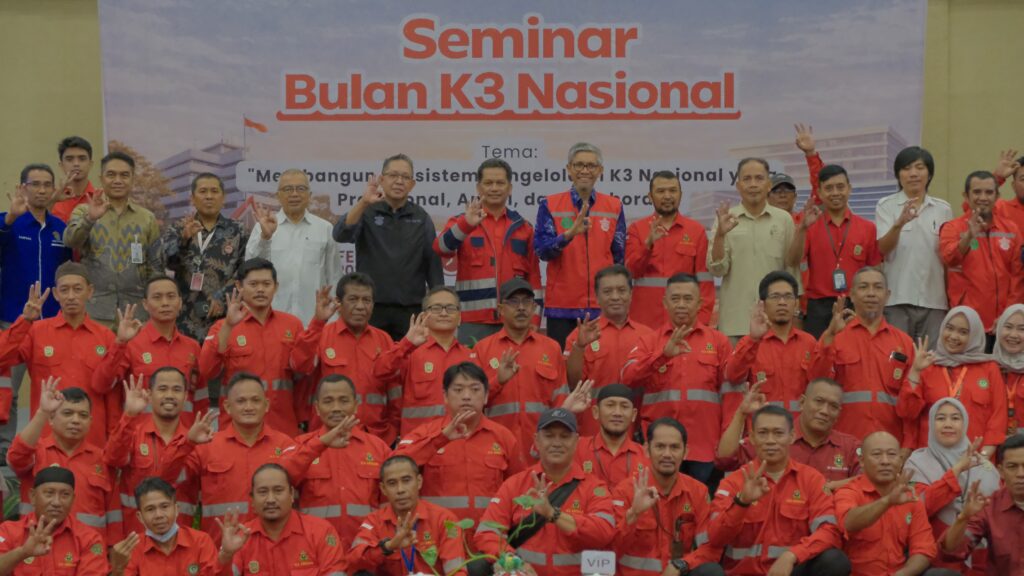
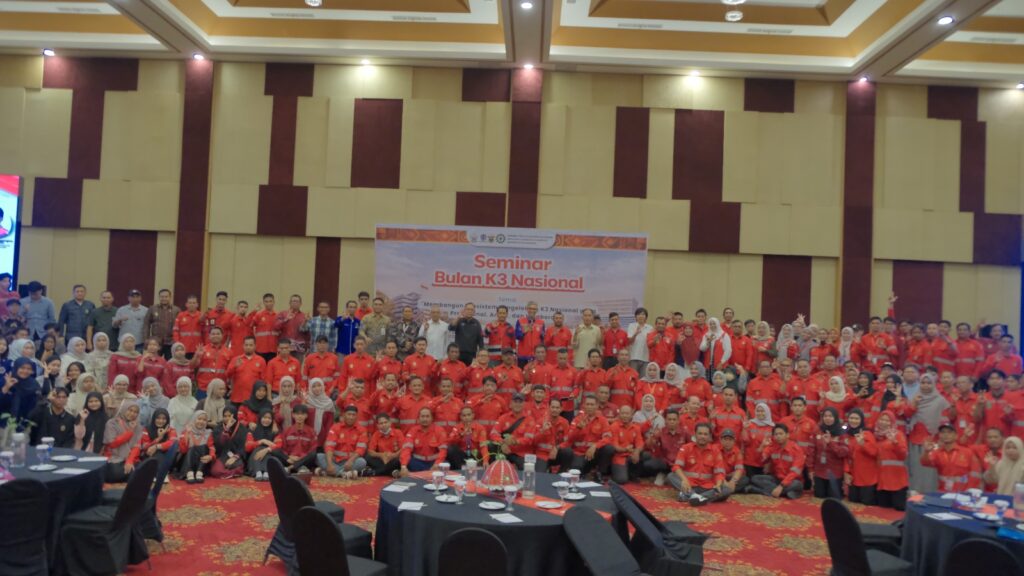
Hasanuddin University (Unhas), through its Directorate of Human Resources, specifically the Subdirectorate of Occupational Safety, Health, and Welfare (K3K), held the National Occupational Safety and Health (K3) Month Seminar in the Ballroom of Hotel Unhas & Convetion on Wednesday (11 February).
Themed “Building a Professional, Reliable, and Collaborative National K3 Management Ecosystem,” the event brought together practitioners, experts, and consultants to discuss strengthening the occupational safety and health (K3) system in the era of digital transformation.
The Head of the South Sulawesi Provincial Manpower and Transmigration Office, Dr. Jayadi Nas., S.Sos., M.Si., attended to discuss K3 Policy in the Digital Era. Dr. Jayadi highlighted several challenges in implementing technology-based K3.
According to Dr. Jayadi, resistance to change remains an obstacle, especially in conservative work cultures and the perception that digital devices are an intrusive form of surveillance.
“Overreliance on technology can weaken K3 culture because of too much dependence on automation or sensors, thereby neglecting basic safety intuition and manual observation of the work environment,” Jayadi explained.
Jayadi stressed that K3 must be a commitment built through habit. “K3 needs to be a commitment born of habit, because we can do it when it becomes habit. K3 never sleeps, because it is always needed,” Jayadi said.
Meanwhile, K3 Consultant St. Nur Insani, ST., emphasized the importance of K3 personnel competence as a strategic investment in safety and productivity.
According to the latest data from the Ministry of Manpower (Kemnaker), 47,300 workplace accident cases were recorded through April 2025. Nur Insani said this underscores the urgent need for competent K3 personnel, given that most workplace accidents are caused by human error and a lack of K3 competence.
“K3 personnel competence is a strategic investment. Let us not treat it as merely an administrative requirement; it is a need that must be prioritized,” Nur Insani stressed.
In the next session, K3 lecturer at the Faculty of Public Health (FKM) of Unhas, dr. M. Furqaan Naiem, M.Sc., Ph.D., presented Unhas’s commitment to realizing “Unhas Excelling Together with K3 Culture.” Dr. Furqaan explained that strengthening K3 culture requires developing comprehensive policies as a sign of the institution’s strong commitment to K3.
“Unhas needs to design a system by implementing an Occupational Safety and Health Management System (SMK3) that is integrated with the university’s operations and governance,” said dr. Furqaan.
Equally important, involving the entire university community is part of the strategy for developing and implementing K3, so that all stakeholders know, understand, and actively contribute to building a safety culture.
Through this seminar, Unhas reaffirmed its commitment to keep strengthening a K3 ecosystem that is professional, adaptive to technological developments, and collaborative in involving all elements of the institution to create a safe and productive working and learning environment. (*aya)
Editor: Ishaq Rahman
This article is an English translation of the original Indonesian report.