
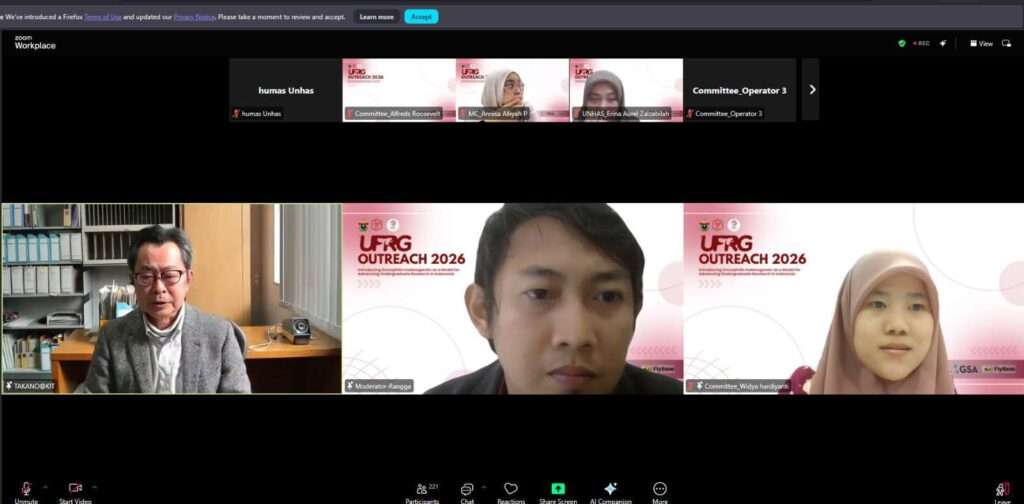
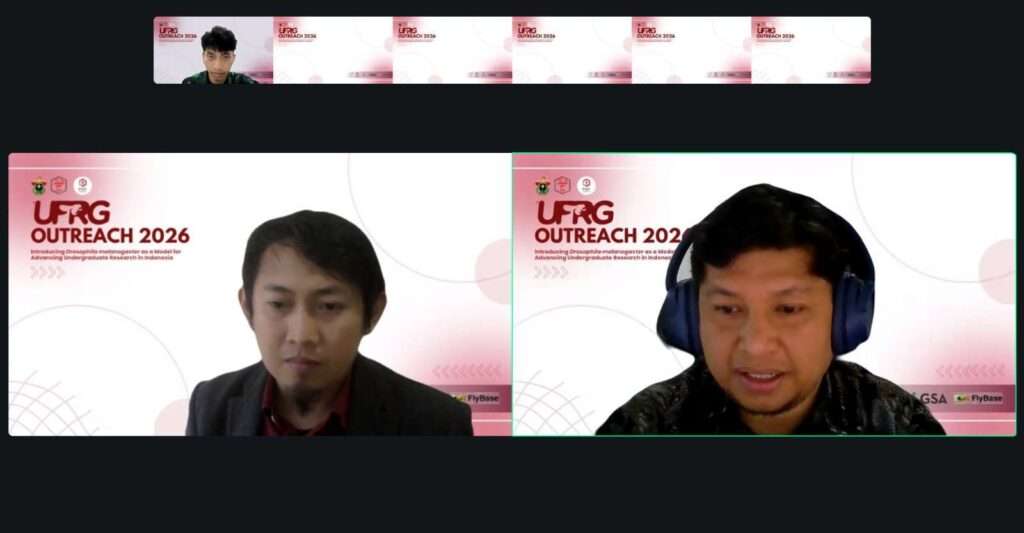
The Faculty of Pharmacy at Hasanuddin University, through the Unhas Fly Research Group (UFRG), held the Fly Research Group Outreach 2026 webinar themed “Introducing Drosophila Melanogaster as a Model for Advancing Undergraduate Research in Indonesia.” It took place virtually via Zoom on Tuesday (10 February).
The event was initiated by UFRG as one of the Thematic Research Groups (TRG). Outreach 2026 is a platform for sharing knowledge, strengthening collaborative networks, and building the research capacity of students and lecturers. Four experienced Drosophila melanogaster (fruit fly) researchers shared scientific insights, research approaches, and the potential uses of fruit flies in various research fields, from genetics and developmental biology to disease and therapy research.
In the report, the Chair of the Organizing Committee, Mukarram Mudjahid, S.Si., M.Si., Apt., explained that Outreach 2026 is part of strengthening international academic cooperation among Hasanuddin University, The University of Queensland, and the University of Cambridge.
The event is designed as a continuing program that will run for two days, with a participatory concept involving lecturer and student representatives from various universities.
“This model is expected not only to provide scientific understanding but also to build soft skills, academic leadership, and research implementation capacity at each institution,” said Mukarram.
Eleven universities outside Unhas expressed interest in taking part, with 13 lecturers representing those campuses and around 100 students with Pharmacy backgrounds joining the event. The UFRG TRG is aiming for cross-university research collaboration based on the fruit fly model.
The Vice Dean for Academic and Student Affairs of the Unhas Faculty of Pharmacy, Prof. Muhammad Aswad, S.Si., M.Si., Ph.D., Apt., stressed that using fruit flies in research has strategic value for the development of science and higher education.
According to Prof. Aswad, the event is a platform for sharing good practices developed at the Unhas Faculty of Pharmacy, while also encouraging a stronger culture of collaborative research. The Unhas Faculty of Pharmacy, which has nine TRGs, is directed to expand the implementation of model-organism-based research and to introduce it more widely to Indonesia’s academic community.
In the presentation session, Prof. Firzan Nainu, S.Si., M.Biomed.Sc., Ph.D., Apt., (Faculty of Pharmacy, Unhas) presented a talk titled “A Small Model for Big Questions: What Drosophila melanogaster Can Teach Us About Human Health, Disease, and Treatments.”
Prof. Firzan explained that Drosophila melanogaster, or the fruit fly, is a very powerful biological model for answering big questions in biology and human health. About 75% of human disease-related genes have functional counterparts in Drosophila, with similarities not only in gene structure but also in biological function and cellular mechanisms. This makes Drosophila highly effective as a screening model for understanding disease mechanisms and developing therapies.
Prof. Firzan also stressed that an organism’s body plan is controlled by a genetic program that works through a hierarchical network of genes and is evolutionarily conserved across species, so findings in Drosophila are relevant for explaining various human diseases, such as cancer, metabolic disorders, degenerative diseases, and inflammatory processes.
“Through UFRG Outreach 2026, Drosophila is positioned as a biological microscope that accelerates research and strengthens the research capacity of Indonesian students,” said Prof. Firzan.
The webinar also featured an international speaker, Prof. Toshiyuki Takano of the Kyoto Drosophila Stock Center, Kyoto Institute of Technology, Japan. Prof. Takano presented “A Drosophila Resource at Kyoto Drosophila Stock Center to Study Human Diseases.”
According to Prof. Takano, using the Drosophila collection enables disease studies to be more systematic, integrated, and efficient, while bridging interdisciplinary approaches from genetics, cell biology, and biomedicine to therapy development.
The Kyoto Drosophila Stock Center serves not only as a provider of research material but also as global scientific infrastructure that accelerates disease research, diagnostic development, and therapeutic innovation based on a complete understanding of biological mechanisms.
Fruit Flies and Virus Interactions
The event then continued with presentations by two other international speakers: Assoc. Prof. Karyn Johnson of The University of Queensland, Australia, and Prof. Tim Weil of The University of Cambridge, United Kingdom, who enriched the perspective on global research and international collaboration based on Drosophila melanogaster.
Assoc. Prof. Karyn Johnson (School of Biological Sciences, The University of Queensland, Australia) presented a talk titled “Drosophila as a Model for Understanding Host–Virus Interactions.” Prof. Karyn explained that understanding host–virus interactions is a key element in controlling infectious diseases, especially those transmitted by insect vectors.
According to Prof. Karyn, Drosophila melanogaster plays a strategic role as a model organism because of the ease of genetic manipulation and the similarity of its basic immune mechanisms to those of higher organisms.
Prof. Karyn further stressed that about 15 percent of infectious diseases in humans are transmitted by insects, especially mosquitoes, which act as vectors of various dangerous pathogens. In that context, Drosophila is used as an experimental model to study how viruses interact with the host immune system.
“This approach allows researchers to identify the molecular pathways and immune responses that play a role in limiting or facilitating viral infection. Findings from Drosophila-based research are expected to become an important foundation for understanding similar processes,” explained Prof. Karyn.
Closing the presentation, Prof. Karyn concluded that microRNA (miRNA) molecules have a broad functional impact on the viral infection process. The influence of miRNA can be specific to certain types of viruses or general across many viruses, so understanding the role of miRNA opens opportunities to develop more effective molecular-based disease control strategies in the future.
At the same session, Prof. Tim Weil (Department of Zoology, The University of Cambridge, United Kingdom) presented a talk titled “Translational Regulation and Protein–RNA Condensates in Early Drosophila Development.” Prof. Weil explained that translational regulation and the formation of protein–RNA condensates in the early stages of Drosophila development are key to understanding how genetic information is precisely controlled from the earliest phase of embryonic life.
Prof. Tim Weil also described how this process is closely related to the stages of oogenesis in Drosophila, from stem cells to the formation of mature oocytes. The distribution and localization of determinant mRNAs, especially bicoid and gurken, play a central role in determining the anterior–posterior and dorsal–ventral axes of the embryo.
As the inaugural event, this activity was made possible by the support of the North American Drosophila Board, managed by the Genetics Society of America (GSA), through which UFRG won an international grant of USD 1,950 to support a workshop titled “Promoting Drosophila as a Model Organism for Undergraduate Research in Indonesia.”
This funding recognizes the quality of the program’s planning and underscores the global scientific community’s confidence in UFRG’s initiative to strengthen Drosophila melanogaster-based research capacity in Indonesia, particularly at the undergraduate level, and to promote the continued expansion of cross-university research collaboration.
In addition to the online webinar, the Fly Research Group Outreach 2026 series will continue in person at the Biopharmacy–Pharmacology and Toxicology Laboratory of the Faculty of Pharmacy at Hasanuddin University through a Drosophila practicum. The activity involves 11 universities in South Sulawesi, reflecting Unhas’s commitment to expanding networks and strengthening research based on model organisms. (*/mir/dhs)
Editor: Ishaq Rahman


This article is an English translation of the original Indonesian report.