
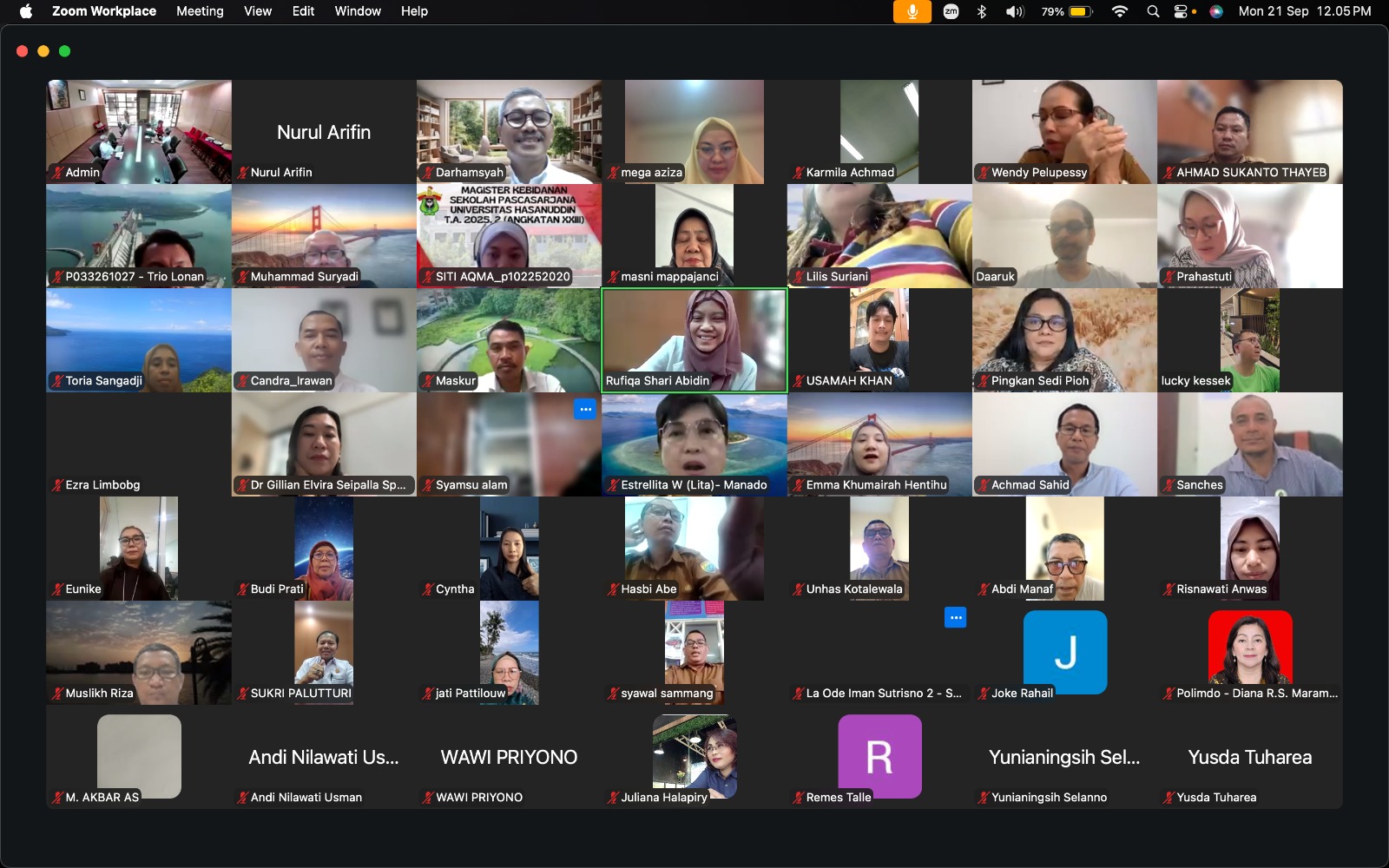
MAKASSAR – The Graduate School of Hasanuddin University held a guest lecture themed Water and Environmental Engineering and Science. The event featured Prof. Dr. Muthukrishna Vellaisamy Kumarasamy of the University of KwaZulu-Natal, South Africa, as the speaker.
Dean of the Graduate School of Hasanuddin University, Prof. Sukri Palutturi, S.KM., M.Kes., M.Sc.PH., Ph.D., expressed appreciation for the speaker’s willingness to share knowledge with the Unhas academic community.
“We see the importance of long-term academic cooperation between Indonesia and South Africa through joint research, student and staff exchanges, and visiting professor programs,” said Prof. Sukri.
Prof. Kumarasamy is a civil engineering academic who leads the Civil Engineering discipline at the University of KwaZulu-Natal and works in research on wastewater and climate change. In the presentation, Prof. Kumarasamy discussed sustainable environmental protection strategies, positioning modeling innovation as an important approach in water resource management.
The material covered water resource management, river basin planning, and flood risk management. Prof. Kumarasamy explained that integrated water resource management needs to connect economic efficiency, social equity, and environmental sustainability.
“Assessing the condition of water bodies must also combine quantitative aspects, such as river discharge, water availability, and groundwater levels, with qualitative aspects covering physical, chemical, and biological indicators,” said Prof. Kumarasamy.
Prof. Kumarasamy also highlighted the pressure that agricultural activity, urbanization, stormwater runoff, wastewater discharge, and industrial activity place on water quality and quantity. In the midst of climate change, water management requires not only field monitoring but also the support of hydrological and water quality models to understand changes, estimate risks, and design pollution control measures more precisely.
One of the main parts of the lecture addressed emerging contaminants in waters, including antibiotic residues, pharmaceutical chemicals, personal care products, and microplastics. Prof. Kumarasamy presented a water quality modeling study in a river basin in South Africa.
“This research used samples from 18 locations, laboratory analysis, and mathematical models to describe the movement and concentration of pollutants along the river,” said Prof. Kumarasamy.
Through the presentation, participants gained an overview of the stages of model development, from collecting discharge and water quality data, identifying parameters, calibration, and validation to simulation. A tested model can help identify locations with high pollutant concentrations while supporting decision-making in river basin protection and sustainable water management.
The session was moderated by Dr. Ir. Darhamsyah, M.Si. At the end of the session, Prof. Kumarasamy opened opportunities for collaboration in joint publications, research projects, visiting positions, student and staff exchanges, thesis and dissertation examination, curriculum development, advisory boards, and joint conferences.
The guest lecture, held online on Monday, 21 September 2026, strengthens the commitment of the Graduate School of Hasanuddin University to expanding its international academic network while offering cross-disciplinary learning relevant to global environmental challenges. (*/sps)
Editor: Ishaq Rahman

This article is an English translation of the original Indonesian report.