
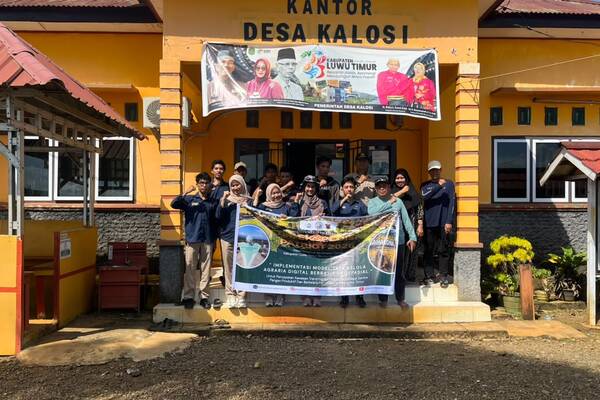
EAST LUWU – Managing a transmigration area depends not only on building infrastructure but also on accurate data as the basis for decision-making. Information on regional conditions, land use, and the area’s potential is an important foundation for designing development that is well targeted and sustainable. Starting from that need, the 2026 Hasanuddin University Patriot Expedition Team introduced an Agrarian Web Geographic Information System (WebGIS) innovation in the Mahalona Transmigration Area, Towuti District, East Luwu Regency.
The program is one effort to apply science and technology in support of transmigration area management. Through a spatial-based digital platform, the team seeks to provide an information system that can help village governments and communities manage agrarian data more systematically, while also serving as a basis for drafting regional development policy.
Mahalona Patriot Expedition Team Leader Ir. Regita Faridatunisa Wijayanti S.T., M.T., M.Sc, explained that the program is designed not merely to produce an application, but also to ensure that the technology can be used sustainably by the community after the assignment ends.
“We have a practical work program, namely building the Agrarian WebGIS application in Mahalona so that it does not end up as just a report. In addition, we also provide training to residents so that the application can be managed independently and have a real impact on the community,” Regita said.
This approach is part of the team’s commitment to delivering solutions that do not end with the community service process, but strengthen the community’s capacity to use technology. Through the training provided, residents are expected to be able to update and develop data independently according to the needs of the area.
The use of WebGIS also opens opportunities for village governments to have a more integrated database to support development planning. With digitally documented spatial information, the process of identifying regional potential and managing resources is expected to become more effective, transparent, and oriented toward community needs.
The innovation developed by the Patriot Expedition Team received a positive response from the East Luwu regional government. Sumarianto, S.P., M.P., Head of the Transmigration Area Development Division at the East Luwu Office of Transmigration and Manpower, said the technology-based approach is in line with the needs of transmigration area development, which increasingly emphasizes the use of data in planning and policy-making.
According to Sumarianto, collaboration between universities and regional governments is a strategic step in delivering solutions that are not only conceptual but can also be applied directly in the community.
“We are ready to accompany the Patriot Expedition Team in Mahalona at every step of their service. We hope the program being developed, especially the Agrarian WebGIS, can become a useful instrument for the community and support the sustainable development of the transmigration area,” Sumarianto said.
This support reflects the importance of collaboration among universities, regional governments, and communities in delivering development solutions based on science. Such synergy is expected to accelerate the implementation of various programs that bring long-term benefits to transmigration areas. For Unhas, the development of the Agrarian WebGIS is one form of downstreaming knowledge from the campus to the community.
Before starting the program, the Patriot Expedition Team built coordination with the regional government, village officials, and the local community to align perceptions of the work program and strengthen collaboration in responding to the needs of the transmigration area.
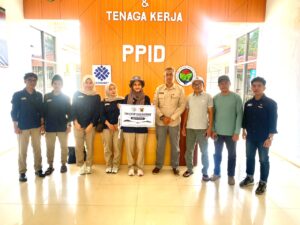
The meeting was also attended by Muhtar, S.P., M.P., Head of the Transmigration Area Preparation and Settlement Development Division; Arif, S.E. and Sugeng Widodo, S.T., Community Self-Reliance Facilitator officers; and local community representatives. The series of activities took place on Sunday, 2 August, in the Mahalona Transmigration Area, Towuti District, East Luwu Regency.
The implementation of the program in the Mahalona Transmigration Area also supports the achievement of the Sustainable Development Goals (SDGs), particularly SDG 9 (Industry, Innovation, and Infrastructure) through the use of digital technology in regional governance, SDG 11 (Sustainable Cities and Communities) through strengthening the area’s information system, and SDG 17 (Partnerships for the Goals) through collaboration among Unhas, the regional government, and the community.
With this approach, the Patriot Expedition is not only a space for community service but also a laboratory for applying science and technology that contributes to the sustainable development of transmigration areas.
The Mahalona Patriot Expedition Team consists of:
Leader: Ir. Regita Faridatunisa Wijayanti S.T., M.T., M.Sc.
Members:
1. Dina Rovivah, S.T
2. Nur Fauziah Faisal, S.Pi
3. La Ode Arus Hidayat, S.Kom
4. Abd. Rahman. S.Hut
5. Muh. Imran Gymnastiar, S.T
(*/tep/mir)
Editor: Ishaq Rahman
This article is an English translation of the original Indonesian report.