

GORONTALO – Achieving national food self-sufficiency takes more than increasing production. Amid the challenges of climate change, market dynamics, and the need for sustainable food systems, research-based innovation is one of the key foundations for strengthening Indonesia’s food security.
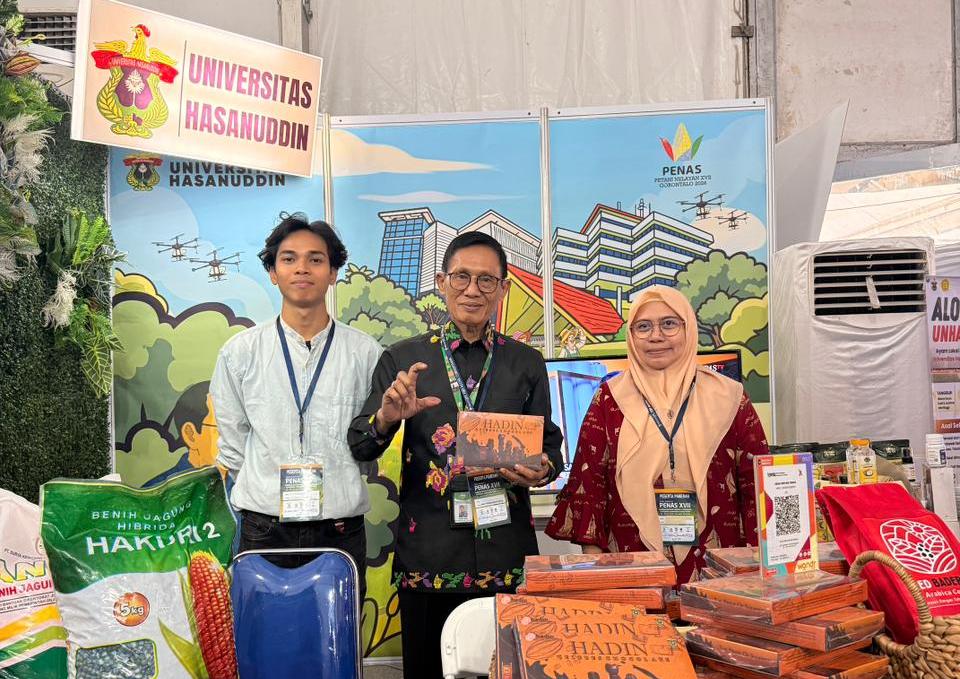
Hasanuddin University (Unhas) took part through its participation in the 17th National Farmers and Fishers Week (PENAS) 2026, held at the David-Tony Sports Center (GOR) area in Limboto, Gorontalo Regency, on 20–25 June 2026.
As a national forum bringing together farmers, fishers, academics, industry players, and food-sector stakeholders from across Indonesia, PENAS is a strategic space for accelerating knowledge exchange, technology dissemination, and cross-sector collaboration. At the event, Unhas took part through the university’s innovation commercialization team, showcasing a range of flagship products from agro-complex cluster research.
PENAS XVII carried the theme “Technology Transformation in Supporting the Food Self-Sufficiency Program to Realize Indonesia as the World’s Food Barn by 2045.” The theme underscores the importance of applying science and technology to support the productivity, efficiency, and sustainability of agriculture, livestock, fisheries, and forestry as the main pillars of national food development.
In the agribusiness exhibition area, Unhas introduced several flagship innovations born of the research and development of its lecturers and researchers, including Jagung Jago corn, Alope chickens, and agricultural drones.
These products address challenges in the agro-complex sector, from raising commodity productivity and adding value to production output to post-harvest management and the sustainable use of natural resources.
The innovations on display drew visitors from many backgrounds, including delegations from the Farmers and Fishers Contact Group (KTNA) from various provinces, business operators, development partners, and regional government representatives. The interactions were not only a way to promote research results but also opened discussions on opportunities to apply the technologies and develop cooperation in various regions.
Unhas Director of Innovation and Intellectual Property, Asmi Citra Malina, S.Pi., M.Agr., Ph.D., explained that participation in PENAS XVII is part of Unhas’s commitment to strengthening the commercialization of research results so that they can benefit society more widely.
“We want to make sure research results do not stop at scientific publications but can be transformed into products and technologies that bring real benefits to farmers, fishers, and business operators, and support the national food self-sufficiency program,” Asmi explained.
Forums such as PENAS also open up opportunities for greater collaboration with strategic partners. Such collaboration is considered important for accelerating technology transfer, expanding market access, and driving sustainable commercialization of research results.
“Commercialization is one of Unhas’s main focuses in building research impact. We continue to encourage innovations born on campus to connect with community needs and contribute to higher productivity and welfare in the national food sector,” said Asmi.
For Unhas, taking part in PENAS is part of a strategy to strengthen a research-based innovation ecosystem that bridges research results with real needs in the field. Campus innovation is expected to generate not only academic value but also measurable economic and social impact.
By presenting a range of leading agro-complex products at the national level, Unhas shows that university research can be a strategic instrument for strengthening food security, improving the competitiveness of the agro-complex sector, and supporting Indonesia’s goal of becoming the world’s food barn by 2045. (*/hki/mir)
Editor: Ishaq Rahman


This article is an English translation of the original Indonesian report.