
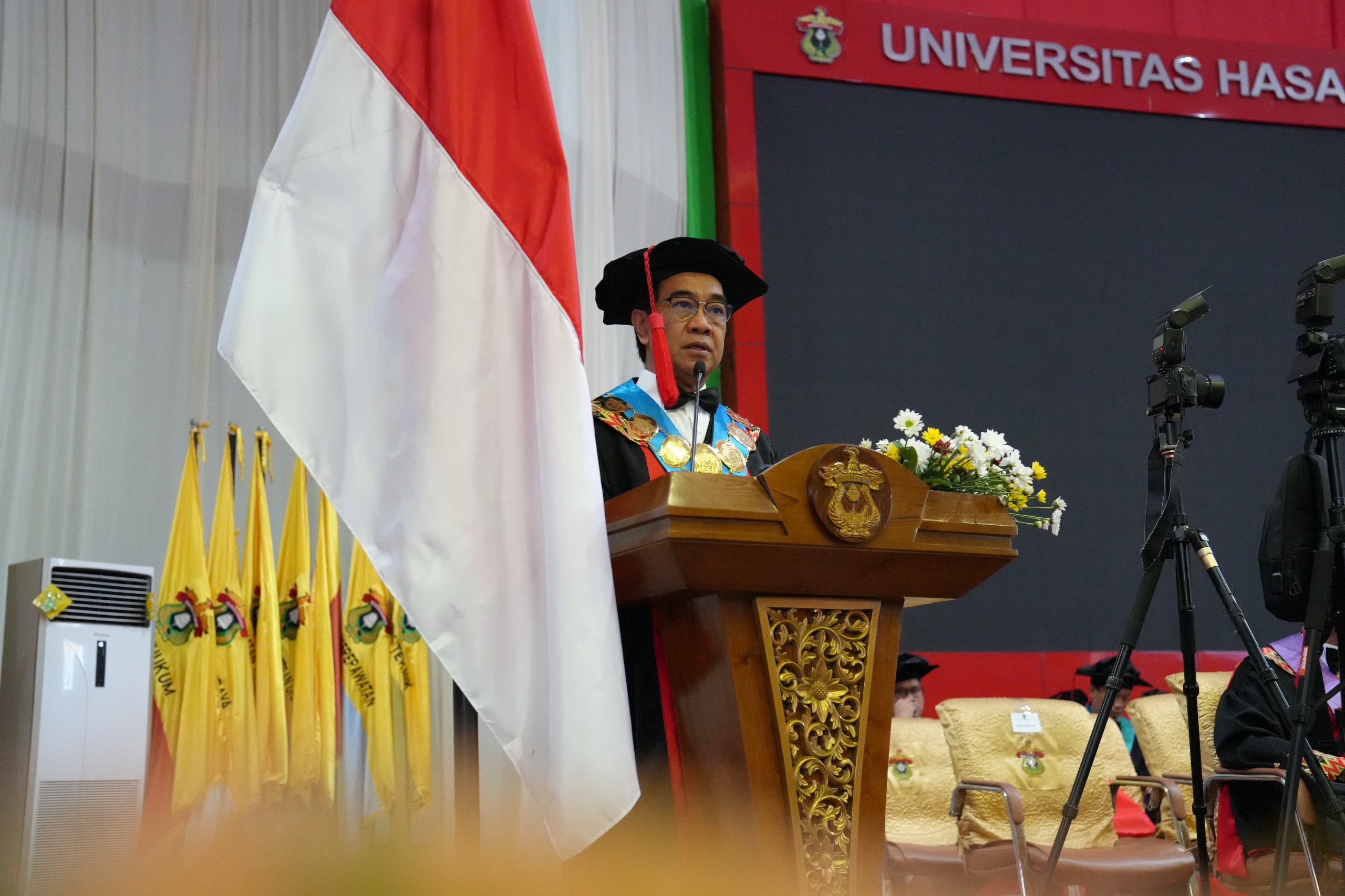
MAKASSAR – Advances in science, accelerating technology, and open cross-border mobility of talent have changed the meaning of an academic degree. Amid these changes, university graduates are no longer expected merely to master a field of study but also to adapt, collaborate, and offer solutions to global problems. That message was the common thread of the speech by Hasanuddin University Rector Prof. Dr. Ir. Jamaluddin Jompa, M.Sc., at the July 2026 Graduation.
According to Prof. JJ, the graduates are now entering an arena very different from the one they entered when they were first admitted as students. The world has moved toward a competition no longer bounded by geography but by the quality of human resources and their ability to create innovation.
“When you walk out of this room, you will no longer face the same world you did when you first became new students. Today’s competition is no longer just between cities or provinces but a competition of talent on the global stage,” explained Prof. JJ.
Starting from these changes, Prof. JJ explained that Unhas’s transformation into a world-class university is not merely an effort to chase positions in various international rankings. More than that, it is a long-term investment in building an ecosystem of education, research, and innovation capable of producing globally competitive graduates.
Unhas is currently strengthening its position as a world-class university by improving academic quality, expanding international collaboration, and building its global reputation. According to Prof. JJ, global recognition of a university has a real impact on its alumni as they enter the professional world.
“When the Unhas name is recognized worldwide, the trust that national and multinational companies place in you will rise sharply. Not only in Jakarta but also in Singapore, Japan, Europe, and wherever you set foot. Unhas graduates must not be underestimated,” added Prof. JJ.
Prof. JJ added that international reputation is built not merely on ranking numbers but on the quality of research and scientists’ real contributions to solving society’s problems. For this reason, the Unhas academic community is encouraged to collaborate ever more actively with scientists worldwide, while students gain access to global learning through various international programs, including double degree schemes with partner universities.
While expanding its international network, Unhas’s development remains grounded in its identity as Indonesia’s maritime campus. Its innovations and research are directed at real challenges, from preserving marine ecosystems and bringing research results to market to strengthening Indonesia’s science diplomacy in international forums. This approach, according to Prof. JJ, is proof that a world-class university must continue to make an impact on the communities around it.
Near the end of the speech, Prof. JJ invited the graduates to reflect on the journey of life through the story of The Odyssey, which tells of Odysseus’s long voyage after winning the Trojan War. In Prof. JJ’s view, the greatest victory is not winning the war but being able to endure the storms that come afterward.
The analogy reflects the idea that completing higher education is not the end of the struggle. An academic degree is the provision for a new journey full of challenges, uncertainty, and rapid change.
“Never ask for calm seas, because history proves that great captains are never born there. As heirs to the seafaring spirit of the Maritime Continent of Indonesia, make the knowledge from this Red Campus your navigation compass and take the helm of your lives. Never have a small mindset. Face every storm of challenge with your head held high, unfurl the sails of courage, and become conquerors of the future’s oceans,” Prof. JJ urged.
At the July 2026 Graduation, Unhas produced 1,355 new graduates from all levels of education. The ceremony took place in two sessions at Baruga A.P. Pettarani, Unhas Tamalanrea Campus, Makassar. The first session on Friday (24 July) involved 668 graduates and the second session on Saturday (25 July) involved 687 graduates.
Of the total, 469 (34.61%) were men and 886 (65.39%) were women. This moment marks the end of their learning at the campus and the start of the alumni’s contributions to advancing knowledge, innovation, and solving the many challenges facing society. (*/mir)
Editor: Ishaq Rahman
This article is an English translation of the original Indonesian report.