
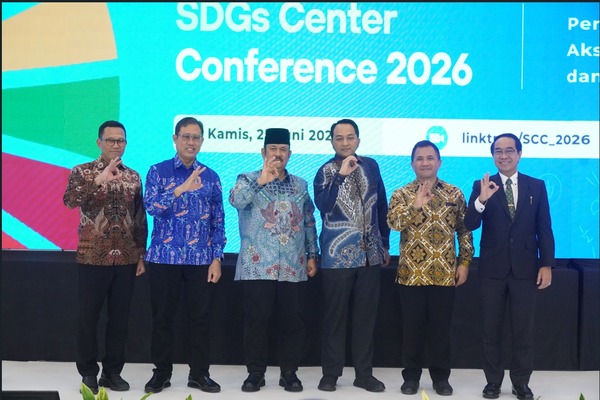
JAKARTA – The Rector of Hasanuddin University, Prof. Dr. Ir. Jamaluddin Jompa, M.Sc., spoke at the SDGs Center Conference 2026 Panel Discussion, themed “Strengthening the Role of SDGs Centers: Driving Local Action for National SDG Achievement and Global Partnership,” on Thursday (25 June) at the Ministry of National Development Planning/Bappenas office.
In the forum, which brought together experts and sustainable development stakeholders, Prof. JJ presented Unhas’s good practices in mainstreaming the Sustainable Development Goals (SDGs) into various aspects of running a university.
Prof. JJ described Unhas’s strategic position as a university that serves not only South Sulawesi and Eastern Indonesia but also the national and global levels. Unhas’s commitment to the SDGs began in 2019 with the establishment of the SDGs Center as a hub for developing and strengthening SDG implementation in Eastern Indonesia. Since then, various policies and programs have been developed to make the SDGs an integral part of university governance.
“Since 2019 we have recognized the importance of strengthening the SDGs Center as an institution. That is why the SDGs are not just talk but are built into our systems, planning, research, and scientific publications so that their impact can be measured,” explained Prof. JJ.
Unhas has integrated SDG indicators into many research proposals and encourages scientific publications linked to sustainable development targets. This allows the university’s academic contributions to be mapped and measured more systematically.
Prof. JJ stressed that strengthening networks and partnerships is an important factor in accelerating institutional transformation. Through broad collaboration, the Unhas SDGs Center is able to widen the impact of its programs while serving as a space for sharing experience with other universities that want to develop similar models.
“With a strong network, transformation can happen faster. Unhas is ready to share its experience and good practices in developing an SDGs Center,” Prof. JJ said.
Internally, SDG implementation involves the active participation of all faculties, work units, and students. Each faculty is encouraged to develop strategic programs that contribute to achieving the SDG targets according to its own characteristics and strengths.
In addition, accountability for program implementation is achieved through a Sustainability Report, which serves as both a reporting tool and a means of evaluating the university’s contribution to the sustainable development agenda.
Prof. JJ also affirmed that the SDGs Center plays an important role as a multi-stakeholder collaboration platform connecting universities, government, industry, communities, and other stakeholders. The SDGs Center not only fosters an inclusive campus but also strengthens the university’s contribution to regional and national development.
Unhas’s main strategy is to include the SDGs in its Strategic Plan (Renstra) and in various institutional planning documents so that every program has a clear direction, targets, and measures of success. Implementation is then reinforced through the tridharma of higher education, partnerships, innovation, and various programs that generate lasting impact.
“What matters most is evidence and showcase. Universities need to show real evidence and present best practices that can be replicated and whose benefits can be extended,” said Prof. JJ.
Minister of National Development Planning/Head of Bappenas, Prof. Dr. Ir. Rachmat Pambudy, M.S., stated in the remarks that the role of SDGs Centers at universities needs to be continuously strengthened. In Prof. Pambudy’s view, SDG implementation is now entering a crucial phase in supporting the realization of Golden Indonesia 2045.
Universities are expected to become centers of research with impact on the environment and society, while developing curricula relevant to future development challenges. In this context, SDGs Centers serve as strategic partners of the government in designing and implementing sustainable development programs.
Through these initiatives, Hasanuddin University positions the campus not only as a center of education and research but also as a development compass that offers science-based solutions to sustainability challenges at the local, national, and global levels. (*/dhs)
Editor: Ishaq Rahman
This article is an English translation of the original Indonesian report.