
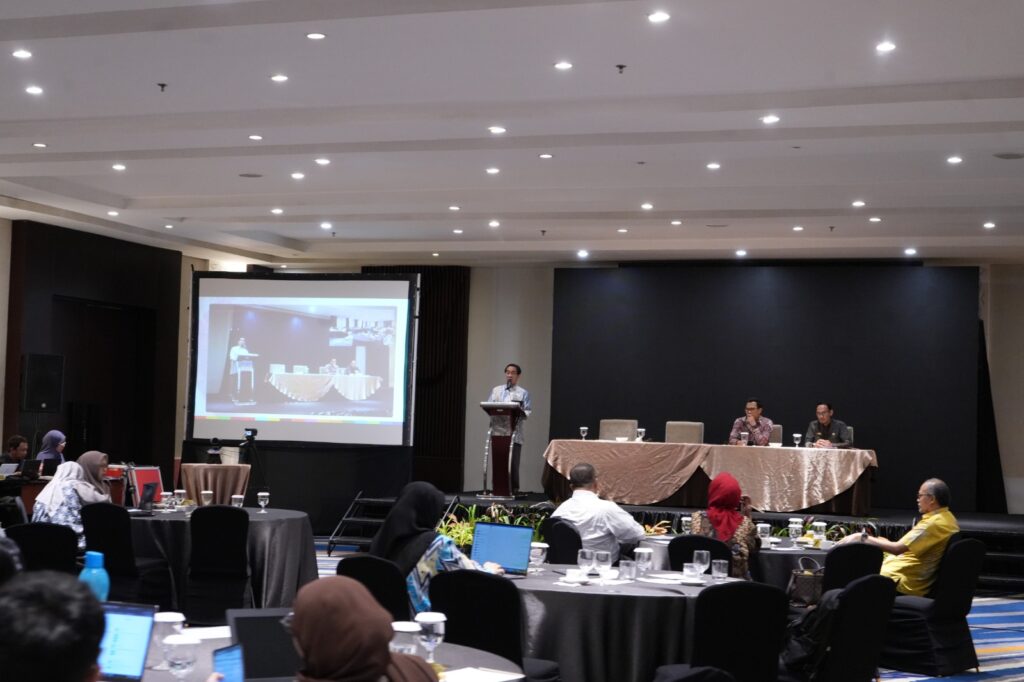
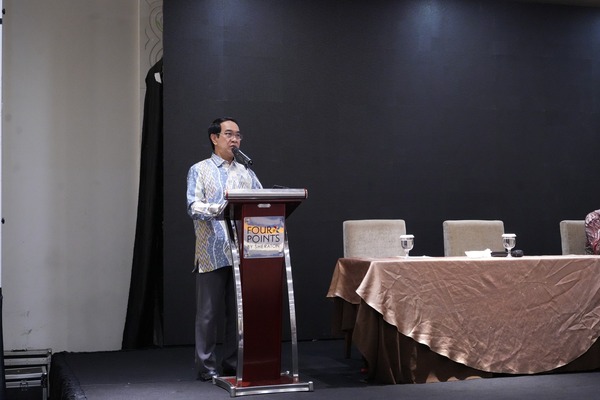
Prof. JJ speaks at the SDGs forum organized by the National Development Planning Agency (BAPPENAS) in Makassar.
Amid growing demands for inclusive and sustainable development, the role of universities has again been affirmed as a key actor in bridging policy and implementation at the regional level. At a strategic forum in Makassar, Hasanuddin University Rector Prof. Dr. Ir. Jamaluddin Jompa, M.Sc., positioned the localization of the SDGs as a crucial point so that the global agenda is truly rooted in local realities.
Prof. JJ stressed that localizing the SDGs through Regional Action Plans (RAD) is not merely a planning formality, but a real instrument for delivering development that has impact. According to Prof. JJ, the success of SDG implementation is largely determined by stakeholders’ ability to translate global goals into contextual policies.
Prof. JJ views a region-based approach as the key to answering diverse development challenges, particularly in Eastern Indonesia. Prof. JJ also highlighted that university involvement in the SDG agenda has now become a measurable mandate. Through Key Performance Indicators (IKU), contribution to the SDGs is no longer normative, but part of the performance measures of higher education institutions.
“Universities today are not enough if they only produce graduates and research; they must also ensure their contribution to achieving the sustainable development goals,” stressed Prof. JJ.
As a demonstration of this commitment, Prof. JJ explained, Unhas has applied a cascading approach down to the level of faculties and schools. Each unit is directed to develop an SDG focus in line with its strengths, so that implementation becomes more specific, targeted, and genuinely impactful.
This approach enables Unhas to contribute more concretely, especially on strategic issues such as health, marine ecosystems, and terrestrial environments, which are both strengths and challenges of Eastern Indonesia.
“Unhas has an SDGs Center that plays a role not only in academic development, but is also actively involved in regional development. Assistance in preparing the SDGs RAD for South Sulawesi Province and Makassar City is clear evidence of that contribution,” Prof. JJ added.
Not only at the planning stage, Unhas also plays a role in monitoring and evaluating SDG achievements to ensure that every program runs effectively and is accountable on a data basis.
Prof. JJ stressed that Unhas’s commitment is to continue being a strategic partner in accelerating sustainable development, particularly in Eastern Indonesia. Prof. JJ hopes that the synergy built can continue in the form of real action in the regions.
These views were delivered at an event organized by the Ministry of National Development Planning/Bappenas through the National Secretariat of the SDGs, held on 29–30 April 2026 at Four Points Makassar.
The forum was attended by representatives of regional governments across Sulawesi, various universities, SDGs Centers, and development partners, who together strengthened capacity and synergy in implementing the SDGs at the regional level. (*/mir)
Editor: Ishaq Rahman
This article is an English translation of the original Indonesian report.