
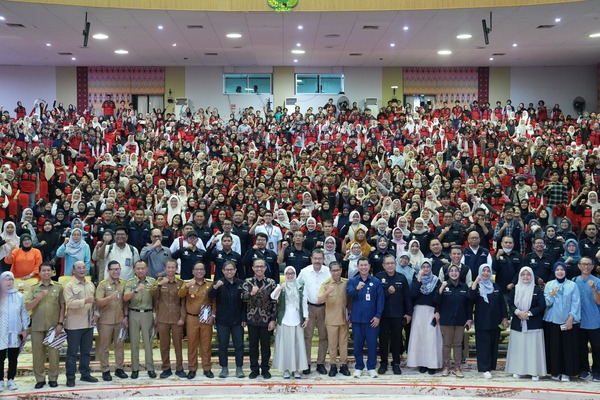
MAKASSAR – Hasanuddin University (Unhas) has affirmed its commitment to connecting knowledge with community needs through the Community Service Program (KKN). A total of 5,282 students were officially sent off to carry out KKN Wave 116, spread across various regions in Indonesia.
Unhas KKN is designed as a multi-stakeholder collaboration space involving students, academics, regional governments, the business sector, and communities. The program aims to deliver solutions based on local potential while strengthening the university’s contribution to sustainable development.
Director of Education Transformation and Learning Innovation (Transdiva) at Unhas, Ir. Sahrianti Saad, S.Hut., M.Si., Ph.D., explained that KKN is run through collaborative governance across units. All stages of the program, from planning to evaluation, are designed in an integrated way to ensure benefits for both students and communities.
“KKN is a joint effort of every part of the university. Cross-sector coordination is the key to keeping the program focused and achieving optimal impact,” said Sahrianti.
Sahrianti added that the KKN process was prepared well in advance through mapping regional needs and coordinating with governments and local partners. After the fieldwork, activities continue with a results seminar and an expo as a means of reflection and dissemination of innovations, while encouraging continued learning.
The students were officially sent off by the Vice Rector for Academic and Student Affairs of Unhas, Prof. drg. Muhammad Ruslin, M.Kes., Ph.D., Sp.BM(K). In remarks, Prof. Ruslin stressed that the success of KKN is measured not by its duration but by the students’ ability to build collaboration and deliver relevant solutions.
“KKN is a space to connect knowledge with community needs. Students must be able to act as mediators who bridge community needs and government policy through an academic approach,” Prof. Ruslin explained.
Prof. Ruslin further described KKN as a “living laboratory” that shapes students’ adaptability, communication, and leadership. Prof. Ruslin also reminded participants to uphold integrity and the good name of the institution throughout their service.
KKN Wave 116 is carried out through four schemes: Regional Innovation KKN, Institutional Collaboration KKN, International Network KKN, and Special KKN.
The KKN Wave 116 schemes of Hasanuddin University are:
Regional Innovation KKN:
– Maros: 336 students
– Pangkep: 293 students
– Barru: 362 students
– Parepare: 170 students
– Sidrap: 1,527 students
– Pinrang: 216 students
– Makassar: 324 students
– Gowa: 40 students
– Takalar: 241 students
– Jeneponto: 193 students
– Bantaeng: 764 students
– Bulukumba: 67 students
– Sinjai: 93 students
– Luwu: 49 students
– East Luwu: 73 students
– North Luwu: 32 students
– Bone: 116 students
– Selayar Islands: 8 students
– Tana Toraja: 47 students
– North Toraja: 91 students
– Wajo: 91 students
– Soppeng: 35 students
– Majene: 37 students
International KKN:
– Malaysia: 74 students
– Japan: 29 students
– Thailand: 12 students
– Taiwan: 6 students
– Hong Kong: 1 student
– Timor-Leste: 5 students
– South Korea: 3 students
Institutional Collaboration KKN:
– South Sulawesi Provincial High Prosecutor’s Office
– Gowa District Prosecutor’s Office
– Makassar District Prosecutor’s Office
– Makassar District Court
– Makassar Military Court
– Maros District Prosecutor’s Office
– Maros Special Child Correctional Institution (LPKA)
– Ministry of Environment (KLH)
– Ministry of Public Works
– Ministry of Social Affairs
– Special Child Correctional Institution (LPKA) Maros
– National Agency of Drug and Food Control (BPOM)
– National Library
– PT. Vale
– PT. Tonasa
Special KKN:
– Makassar (Achievement Theme)
– East Luwu (Co-ops Vale Theme)
The students will be placed in 8 countries, 2 provinces, and 23 regencies/cities, covering 135 districts and 613 villages/sub-districts. A total of 205 lecturers will serve as supervisors during the program.
The send-off ceremony took place at Baruga A.P. Pettarani on Monday (29 June) and was attended by university leaders and regional government representatives, as a show of strengthened synergy between the university and the government in supporting development based on local potential.
Editor: Ishaq Rahman
This article is an English translation of the original Indonesian report.