
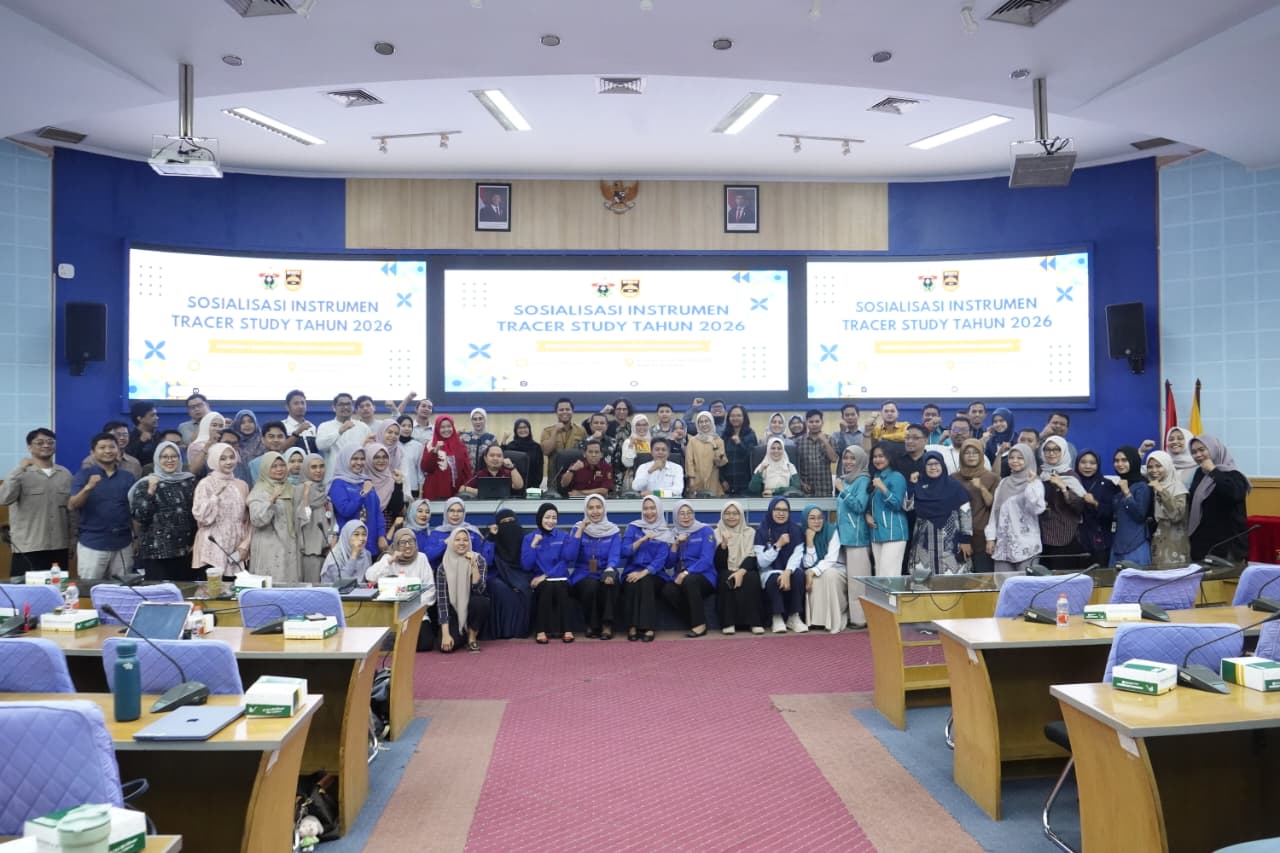
MAKASSAR – Graduates’ trajectories after completing their education are an important source of information for universities in evaluating how relevant the learning process is to the needs of the workplace. To that end, Hasanuddin University (Unhas) is strengthening its alumni tracking through the 2026 Tracer Study Instrument Briefing, held on Tuesday (18 August) in the Senate Meeting Room, 2nd Floor of the Unhas Rectorate Building. The event was attended by faculty working group (Pokja) administrators who are responsible for entering tracer study data.
Unhas Vice Rector for Partnerships, Internationalization, and Alumni Affairs, Prof. Ir. Suharman Hamzah, S.T., M.T., Ph.D. (Eng.), HSE-Cert, reminded participants that the tracer study should not be viewed as a routine administrative activity carried out every year. Alumni data holds a strategic position in reading educational outcomes and determining the direction of the university’s development.
“With valid and adequate data, we have a picture of how well the academic processes we carry out match the needs of society and the workplace. That is why tracer study results are vitally important,” said Prof. Suharman.
Prof. Suharman urged the faculty working group administrators to give the greatest possible support to efforts to complete the alumni data. The quality and completeness of the data, Prof. Suharman said, will determine how well Unhas can use alumni information as material for evaluation.
“We must not let the data we have go unused. We want to improve Unhas’s reputation and achieve the targets that have been set. For that, support from all parties is essential,” said Prof. Suharman.
Tracer study data can help the university see graduates’ journeys after completing their education, including how the competencies acquired on campus connect with the needs of the workplace. That information can be used to evaluate various aspects of education delivery and to support the university’s program development going forward.
“We are evaluating our long journey. We hope for everyone’s support so that this activity has a major impact on the development of the university’s activities in the future,” said Prof. Suharman.
Unhas Director of Alumni Relations, Prof. Ir. Muhammad Yusuf, S.Pt., Ph.D., IPU., also encouraged stronger management of alumni data as part of developing the university’s relationship with its graduates.
The involvement of faculty working group administrators in this briefing is expected to smooth the process of collecting and entering tracer study data at the faculty level. The data collected can then serve as an information base for Unhas in conducting evaluations and designing educational development that is more responsive to the needs of graduates, the workplace, and society. (*/dhs)
Editor : Ishaq Rahman
This article is an English translation of the original Indonesian report.