
Hasanuddin University (UNHAS) continues to strengthen its commitment to supporting scholarship recipients in completing their studies successfully. Within the graduation records covered by the analysis, 1,147 of 1,690 undergraduate scholarship recipients were recorded as graduates, equivalent to 67.87 percent. The remaining 543 students, or 32.13 percent, were not recorded as graduates within the analysis period.
This result provides an important indicator for monitoring student progression and evaluating the academic and financial support provided to scholarship recipients.
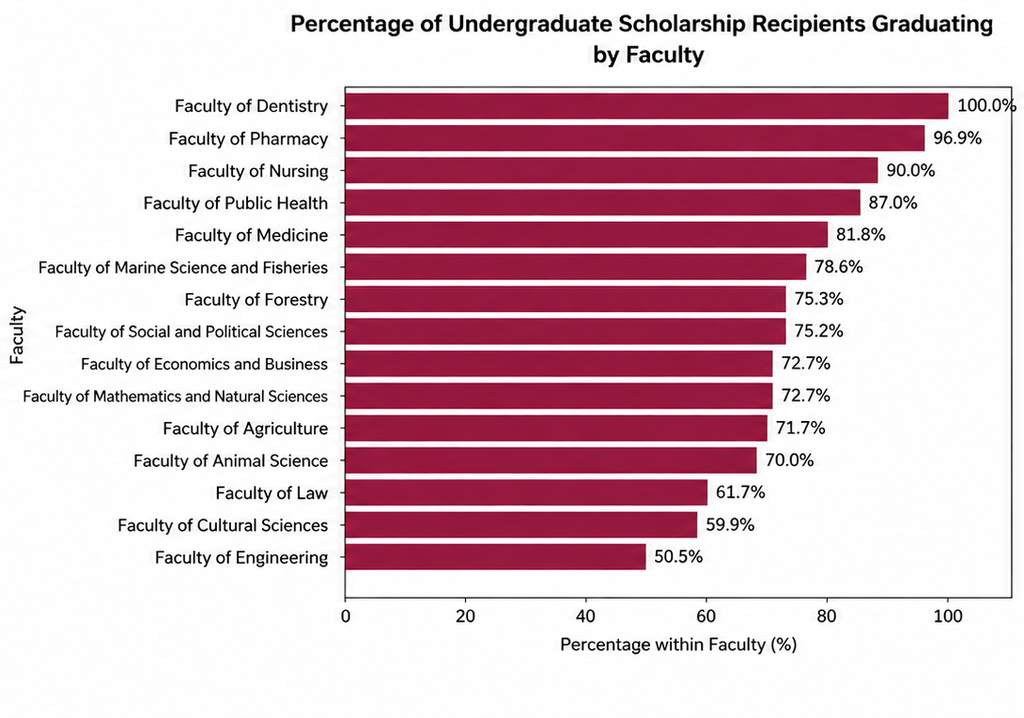
At the faculty level, the graduation percentage is calculated against the total number of undergraduate scholarship recipients within each faculty. The Faculty of Dentistry recorded the highest percentage at 100.0 percent, followed by Pharmacy at 96.9 percent, Nursing at 90.0 percent, and Public Health at 87.0 percent. Medicine recorded 81.8 percent, while Marine Science and Fisheries reached 78.6 percent.
Forestry recorded 75.3 percent, Social and Political Sciences 75.2 percent, Economics and Business and Mathematics and Natural Sciences 72.7 percent each, Agriculture 71.7 percent, and Animal Science 70.0 percent. Law recorded 61.7 percent, Cultural Sciences 59.9 percent, and Engineering 50.5 percent.
The variation across faculties indicates that study-completion dynamics are not uniform. Monitoring and support should therefore consider the academic characteristics of each faculty, including study progress, final-project completion, and student-support needs.
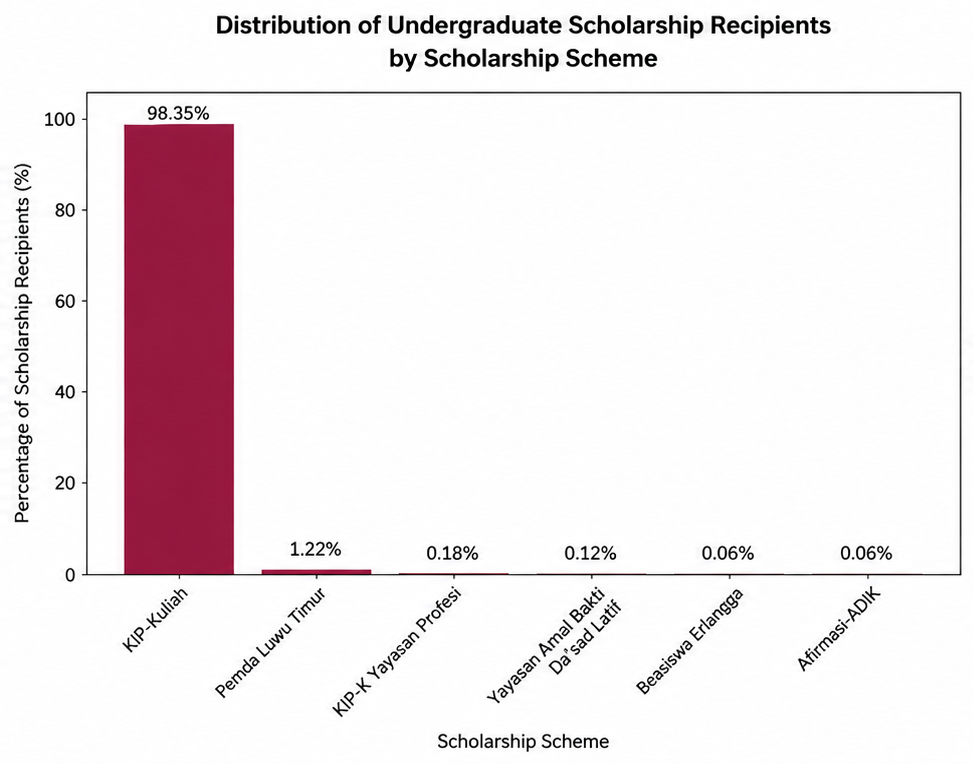
The undergraduate scholarship data also show a strong concentration in the KIP-Kuliah scheme. In the available scholarship-scheme dataset, 1,610 students, or 98.35 percent, were KIP-Kuliah recipients. The Luwu Timur Regional Government Scholarship covered 20 students or 1.22 percent, KIP-K / Advanced Professional Study three students or 0.18 percent, Yayasan Amal Bakti Da’sad Latif two students or 0.12 percent, while the Erlangga Scholarship and Afirmasi-ADIK each accounted for one student or 0.06 percent.
From Access to Completion
For UNHAS, scholarship policy is not only about expanding access to higher education; it is also closely linked to study continuity, academic progression, and degree completion. Faculty-level and scholarship-scheme data can provide a basis for identifying student groups that may require more targeted support.
Support can be strengthened through more intensive academic advising, monitoring of study progress, identification of remaining credit requirements and final projects, and improved coordination among study programs, faculties, and scholarship administrators. This mapping also helps the university recognize that each scholarship scheme and faculty may involve different student characteristics and academic challenges.
UNHAS does not view graduation figures solely as an institutional performance indicator. The data can also serve as an instrument for strengthening student support. Students who have not been recorded as completing their studies within the analysis period can be identified earlier so that academic and non-academic barriers can be better understood.
With 67.87 percent of undergraduate scholarship recipients recorded as graduates within the analyzed data, UNHAS can continue strengthening monitoring and support for students who remain in the study-completion process. The university’s commitment extends beyond providing access through scholarships to ensuring that students receive adequate support to progress academically and complete their degrees.