
MAKASSAR – Rice is a staple food that is almost always available in every Indonesian household. During storage, however, rice quality often declines due to attacks by rice weevils (Sitophilus oryzae), small insects that can speed up spoilage, lower quality, and increase post-harvest losses.
Until now, some people still rely on synthetic pesticides or storage methods that are not entirely safe for food.
This problem has spurred various innovations based on natural materials. One was developed by the PHARMACOUNT Team from Hasanuddin University through RICEVA (Rice Protection with Natural Volatile Aroma), a paper strip that uses citronella essential oil and pandan wangi extract as sources of natural volatile compounds to help protect rice during storage.
Scientifically, citronella essential oil is known to contain compounds such as citronellal, citronellol, and geraniol, which have a distinctive aroma and have been widely studied for their repellent activity against various types of insects. Meanwhile, pandan wangi produces natural aromatic compounds that not only give it a distinctive scent but may also strengthen the pest-repelling effect.
Through a paper strip formulation, the two ingredients are designed to release volatile compounds gradually, helping create a storage environment that rice weevils find less appealing without direct contact with the food.
PHARMACOUNT Team Leader Humairah Afifah explained that RICEVA’s advantage lies in its use of natural ingredients that are safe for food storage, in a simple and practical form of use.
“We hope RICEVA can become a safer, more practical, and environmentally friendly alternative for protecting rice,” Humairah said.
This approach is in line with growing attention to the use of botanical pesticides as part of more sustainable food storage systems. Using local biological materials not only has the potential to reduce dependence on synthetic chemicals but also opens opportunities to downstream Indonesian agricultural commodities into value-added products.
According to Humairah, RICEVA is designed for wide use, from households and students living in boarding houses to food MSMEs and rice and grocery stores. The paper strip form makes the product easy to place inside storage containers without special handling.
Even so, developing science-based innovation does not stop at the concept design stage. To ensure the product’s effectiveness and safety, the PHARMACOUNT Team plans to build a prototype, test the paper strip’s ability to inhibit rice weevil attacks, and refine the business model before wider implementation.
The process of creating RICEVA also shows the importance of cross-disciplinary collaboration. Humairah explained that the team conducted a literature study, market analysis, business model development, and a business feasibility analysis.
“The biggest challenge was integrating health, product innovation, and business strategy into one comprehensive proposal. Collaboration between Pharmacy and Accounting students was the main strength in building a solution that is not only scientifically feasible but also has the potential to be developed as a commercial product,” Humairah said.
Unhas Director of Student Affairs Prof. Dr. Ir. Suhasman, S.Hut., M.Si., IPM, explained that the PHARMACOUNT Team’s success is proof of research-based student innovation.
“This innovation answers an everyday problem faced by the public, and it is built on a scientific basis as the result of strong research,” said Prof. Suhasman.
For the PHARMACOUNT Team, the competition was not merely a chance to win awards. The experience was a learning space to test ideas, build cross-field collaboration, and sharpen critical thinking and entrepreneurial skills.
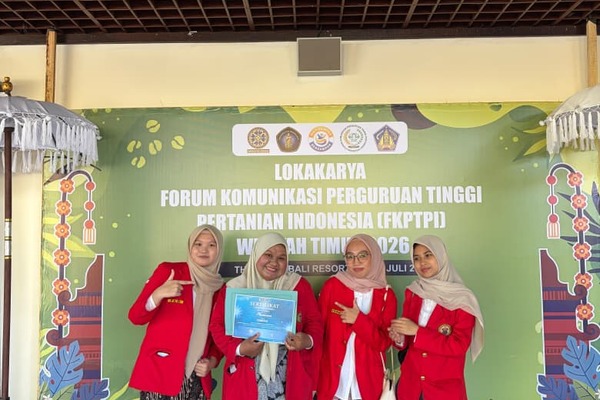
The RICEVA innovation led the PHARMACOUNT Team to Third Place in the Business Plan Competition at the 2026 Eastern Region Workshop of the Indonesian Agricultural Higher Education Communication Forum (FKPTPI). The competition was organized by the Student Executive Board of the Faculty of Agriculture, Udayana University, at The Patra Bali Resort & Villas, Bali, on 23 July 2026. The competition began with a proposal selection from various public and private universities in Indonesia before the finalists presented their ideas before a panel of judges.
Unhas PHARMACOUNT Team:
1. Humairah Afifah (Pharmacy 2023),
2. Afiya Nahda Hesa (Pharmacy 2024),
3. Artika Sari Supardy (Accounting 2024),
4. Adinda Yulia (Accounting 2024)
Supervising Lecturer: Prof. Dr. Herlina Rante, S.Si., M.Si., Apt.(*/kmhs)
Editor: Ishaq Rahman
This article is an English translation of the original Indonesian report.