
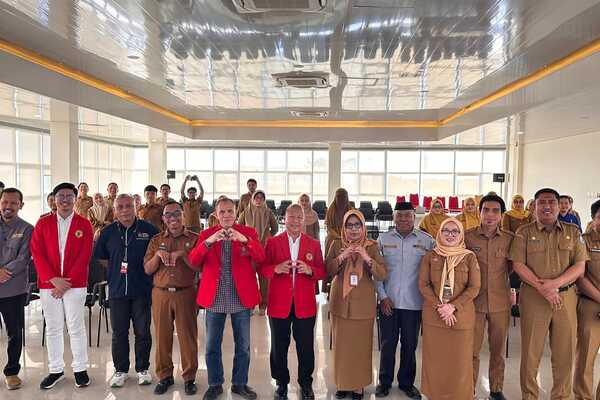
BULUKUMBA – As room for collaboration between regions around the world grows wider, local governments no longer serve only as implementers of domestic policy. They are also expected to build international networks that have an impact on regional development. This awareness underpins the Hasanuddin University Community Service Program (PPMU-PK-M) on the theme “Strategy for Strengthening the Capacity of Human Resources in the Bulukumba Regency Government Apparatus to Promote the Effectiveness of Regional International Cooperation.”
The program is a strategic forum that brings academics and local government together to discuss how Bulukumba can use its local potential as a gateway to international cooperation.
Leader of the Hasanuddin University Community Service Team and Head of the Master’s Program in International Relations at the Faculty of Social and Political Sciences (FISIP), Prof. Drs. Darwis, MA, Ph.D., stressed that the era of regional autonomy has opened opportunities for regency and city governments to forge partnerships with local governments abroad. However, those opportunities can only be realized if backed by government personnel who understand the governance of international cooperation, from planning and proposal writing to program implementation.
“International cooperation is not merely the signing of a memorandum of understanding, but a development instrument that must produce real benefits for the community. That is why strengthening the capacity of government personnel is an important investment so that every regional potential can be translated into an opportunity for global collaboration,” said Prof. Darwis.
The event then continued with a presentation on strategies for strengthening the capacity of local government personnel to promote the effectiveness of international cooperation. The discussion moved on to the various challenges faced by local governments, from mapping potential and drafting cooperation documents to the importance of building networks with international partners that share characteristics similar to Bulukumba’s.
A more practical perspective was offered by community service team member Ishaq Rahman, S.IP., M.Si. This Unhas International Relations lecturer reviewed the urgency, mechanisms, and opportunities of international cooperation for the Bulukumba Regency Government. Ishaq explained that regional diplomacy is now an important instrument for accelerating development through cross-border collaboration.
“Bulukumba has many assets that can be promoted internationally, from the maritime sector and the Pinisi boat industry to tourism and leading commodities. The challenge is not a lack of potential but how that potential is packaged into cooperation proposals that are attractive and match the needs of prospective partners,” Ishaq said.
The participants’ enthusiasm was evident in the discussion session. Various regional apparatus organizations used the opportunity to explore strategies they can apply in their respective fields.
From the Fisheries Office, Yusli highlighted cooperation opportunities that can be built on Bulukumba’s maritime identity. Yusli noted that the regency has a history of cooperation with Brunei and experience exporting to Saudi Arabia through business operators.
“This potential can be strengthened through a combination of business-to-business (B to B) and government-to-government (G to G) approaches, including by using the cultural value of the Pinisi and historical ties with the Aboriginal community as a gateway for regional diplomacy,” said Yusli.
Meanwhile, Endang from the Bulukumba Regency Regional Research and Development Planning Agency (Baperida) raised a different issue. Endang asked about strategies for improving the presentation quality of the regency’s various innovations, which have attracted attention in numerous competitions but have not achieved the best results because of how they were presented.
“We also need input on potential forms of international cooperation to support the development of regional innovation,” said Endang.
Another question came from Widi of the Bulukumba Regency Tourism Office. Widi explained that Bulukumba has around 140 tourist destinations with great potential to be promoted internationally.
“The main challenge is not only promotion but also how to build mentoring mechanisms and coaching clinics that can help local governments draw up international cooperation strategies in the tourism sector,” said Widi.
All of these questions opened a discussion that showed how greatly local government personnel need ongoing mentoring in designing more focused regional diplomacy.
The event was attended by Assistant for General Administration of the Bulukumba Regency Regional Secretariat, Dra. Hj. Umrah Aswani, MM, representing the Regional Secretary of Bulukumba Regency. Also present were Head of Bulukumba Regency Baperida Andi Irma, ST., MM, the Bulukumba Regency Inspector, the Head of the Bulukumba Regency Office for Women’s Empowerment, Child Protection, Population Control, and Family Planning, secretaries of regional apparatus organizations, and OPD representatives from across Bulukumba Regency.
The Hasanuddin University community service team involved in the event consisted of Prof. Drs. Darwis, MA, Ph.D., Ishaq Rahman, S.IP., M.Si., Munjin Syafiq, S.IP., M.Si., Munif Ranti Arif, S.IP., M.A., Fajhriadi Hastira, S.IP, M.Si, and two students of the Department of International Relations at Hasanuddin University.
Through this community service program, Hasanuddin University affirms its commitment to providing mentoring that strengthens local governments’ capacity to use international cooperation opportunities as a development instrument. With increasingly prepared personnel, Bulukumba is expected to turn its maritime, cultural, and tourism wealth into a bridge to global collaboration that brings real benefits to the community.
The program also supports the achievement of the Sustainable Development Goals (SDGs), particularly SDG 4 (Quality Education) through knowledge-based capacity building and knowledge transfer for government personnel; SDG 8 (Decent Work and Economic Growth) by encouraging investment, trade, and regional economic development opportunities through international cooperation; SDG 16 (Peace, Justice, and Strong Institutions) by strengthening local governance that is professional and adaptive to global dynamics; and SDG 17 (Partnerships for the Goals) by strengthening collaboration between universities and local governments as a foundation for building sustainable international partnership networks.
The event took place at the Pinisi Building in Bulukumba Regency on Tuesday, 4 August 2026. (*/ir)
Editor : Ishaq Rahman
This article is an English translation of the original Indonesian report.