
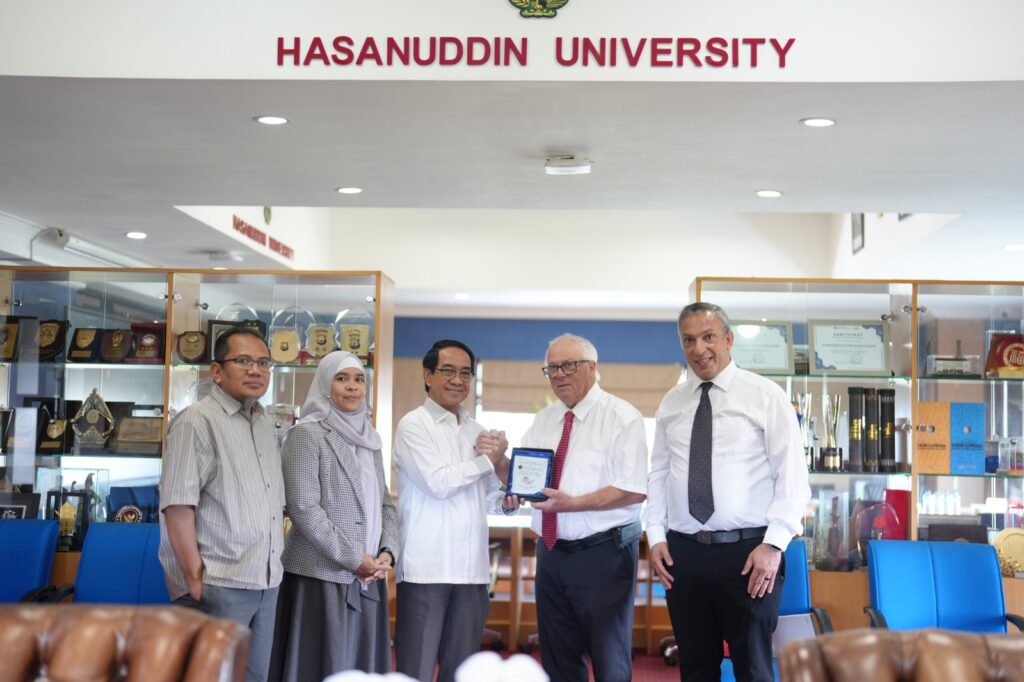
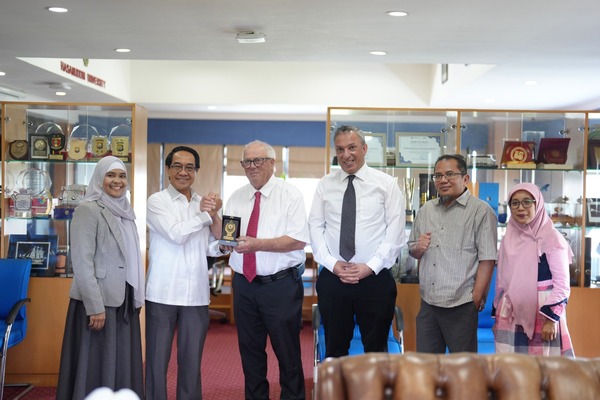
Rector of Hasanuddin University Prof. Dr. Ir. Jamaluddin Jompa, M.Sc., received a visit from a Poultry Breeding research team from the University of Arkansas, United States. The visit, led by Prof. Douglas D. Rhoads, Director of the Center of Excellence for Poultry Breeding at the University of Arkansas, took place in the Rector’s Room on the 8th Floor, Hasanuddin University Tamalanrea Campus, Makassar, on Monday (26 January) at 11:30 WITA (Central Indonesia Time).
Accompanying from Unhas were Prof. Dr. Muhammad Ihsan Andi Dagong, S.Pt., M.Si (Vice Dean for Cooperation, Research, and Innovation of the Unhas Faculty of Animal Science) and the faculty’s research team. The University of Arkansas research team included Dr. Adnan Ali Khalaf Alrubaye (senior researcher and Secretary of the Center of Excellence for Poultry Breeding).
Prof JJ said that Unhas is committed to promoting the development of excellent research based on local potential and reinforced through global collaboration. Synergy with international institutions is a strategic step in improving the quality and competitiveness of Unhas research.
Unhas has produced various excellent research products in animal science, one of which is the ALOPE chicken, a result of poultry research development and tangible proof of the research capacity of the Unhas academic community.
“International research cooperation like this is very important for strengthening scientific capacity and innovation, especially in the field of poultry. We hope this collaboration will further enrich the development of research, technology, and human resources in poultry farming,” explained Prof JJ.
The meeting between Unhas and the University of Arkansas was specifically intended to strengthen international research cooperation in poultry farming. Prof. Douglas D. Rhoads presented a series of activities to be carried out with the Unhas Faculty of Animal Science, including academic activities and field research at broiler chicken farming centers managed by the Unhas Faculty of Animal Science.
“In the next few days, we will visit a number of poultry development facilities managed by the Faculty of Animal Science,” said Prof Douglas.
The research collaboration between the Unhas Faculty of Animal Science and the University of Arkansas Poultry Breeding research team is carried out through a collaborative research cooperation scheme funded by the Thematic Research Group (TRG) Poultry Breeding program. The TRG Poultry Breeding program is chaired by the Unhas Faculty of Animal Science TRG Poultry Breeding Team Leader, Dr. Wempie Pakiding, who coordinates the implementation of the collaborative research and the strengthening of the poultry research ecosystem at Unhas.
The University of Arkansas research team was at the Unhas Campus from 24 to 27 January to carry out a series of academic activities and field research. During the visit, the team conducted direct research at broiler chicken farming centers. The field research focused on surveying the incidence of Lameness disease in broiler chickens.
Lameness is caused by a bacterial infection known as Lameness Bacterial Chondronecrosis with Osteomyelitis (BCO), which can cause significant economic losses for broiler operations. The research is expected to produce comprehensive scientific data on the prevalence and risk factors of BCO in broiler farming systems in Indonesia.
The research results are expected to serve as a basis for developing evidence-based strategies for preventing and controlling poultry diseases, while supporting improved productivity and sustainability of broiler farming. The research also involves two early-career researchers at the postdoctoral and doctoral levels, Dr. Andi Asnayanti and Dr. Dang Trieu, as part of cross-country and cross-generational research collaboration.
The University of Arkansas is known as one of the world’s leading higher education institutions and research centers in poultry science, especially broiler research. Going forward, this cooperation is planned to be developed on a continuing basis.
The cooperation to be developed in the future includes strengthening international collaborative research, developing human resource capacity, further study opportunities, and developing research on key commodities such as rice and poultry. (*/mir)
Editor: Ishaq Rahman
This article is an English translation of the original Indonesian report.