
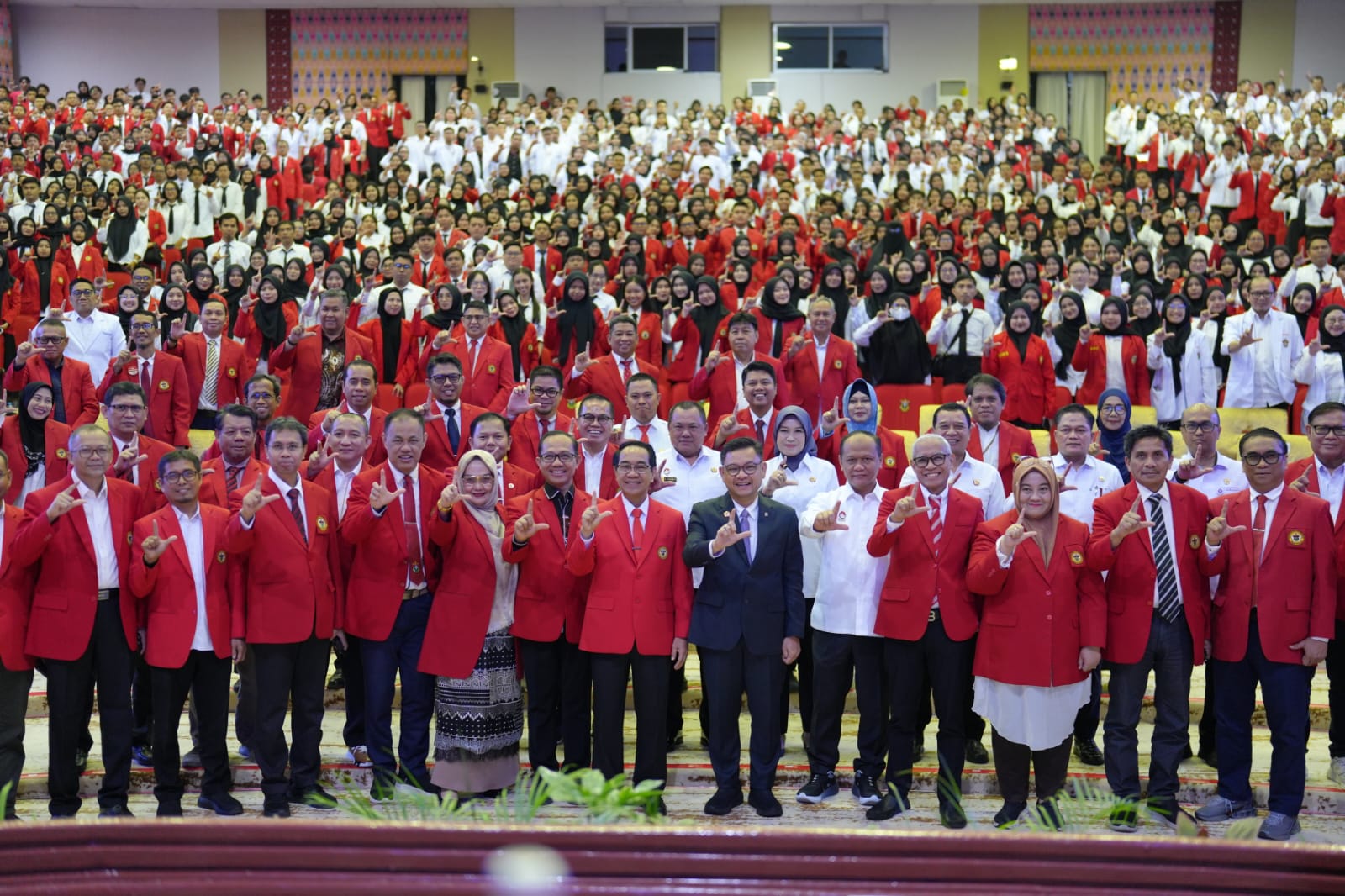
MAKASSAR – Hasanuddin University (Unhas) has admitted 2,462 new graduate students for the first semester of the 2026/2027 academic year. The official welcoming ceremony took place on Thursday, 13 August 2026, at Baruga A.P. Pettarani, Unhas Tamalanrea Campus.
They were selected from 4,308 applicants across all graduate levels, including doctoral, master’s, specialist, subspecialist, and professional programs. Unhas Vice Rector for Academic and Student Affairs Prof. Muhammad Ruslin, drg., M.Kes, Ph.D., Sp.B.M.Mf., Subsp.Ortognat.D., explained that this high level of interest indicates Unhas’s increasingly mature standing as a research university.
At the master’s level, applicants were spread across study programs in 17 faculties. The Law study program recorded the most applicants with 235, followed by Management with 157 and Nursing with 100. At the doctoral level, Public Health recorded 94 applicants, Management 90, and Law 82.
“This distribution shows that advanced education at Unhas attracts interest from a wide range of disciplines, from the social sciences and humanities, health, engineering, and science to natural resources,” said Prof. Ruslin.
The 2026/2027 academic year also saw 81 new international students enrolled across 22 master’s programs and 10 doctoral programs, coming from 14 countries.
Unhas Rector Prof. Dr. Ir. Jamaluddin Jompa, M.Sc., said the large number of graduate students is a proud achievement. However, the figure also carries a greater responsibility, especially to ensure that graduate education produces new ways of thinking that can contribute to the nation’s competitiveness.
According to the Rector, entering graduate school means entering an academic phase with different demands. While undergraduate education largely provides a scientific foundation, graduate education must push students to question, test, discover, and propose new ideas.
“When you enter graduate school, we hope for a change in the way of thinking. Many things have to change. Students no longer simply learn from what already exists, but begin to produce new thinking, research, and ideas,” said the Rector.
Graduate students are therefore expected to take on a greater role in addressing real-world problems. The research they carry out needs to be relevant, generate innovation, and, at a later stage, be developed further to add value for society and strengthen the nation’s competitiveness.
“We want graduate education to produce people who can think more independently and produce more, and more useful, research. From there, innovation is born, which can then be taken downstream into technologies and solutions that add value,” the Rector explained.
Distribution of New Graduate Students, First Semester 2026/2027, by Level of Study:
– Doctoral Program: 464 students
– Master’s Program: 1,345 students
– Medical Specialist Program: 359 students
– Medical Subspecialist Program: 33 students
– Professional Program: 261 students.
Distribution of New Graduate Students, First Semester 2026/2027, by Faculty:
1. Faculty of Economics and Business
– Master’s: 231 students
– Doctoral: 74 students
– Professional: 10 students
2. Faculty of Law:
– Master’s: 223 students
– Doctoral: 44 students
3. Faculty of Medicine:
– Master’s: 8 students
– Doctoral: 25 students
– Specialist/Subspecialist: 306 students
4. Faculty of Engineering:
– Master’s: 180 students
– Doctoral: 80 students
– Professional: 22 students
5. Faculty of Social and Political Sciences (ISIPOL):
– Master’s: 100
– Doctoral: 52
6. Faculty of Cultural Sciences:
– Master’s: 37
– Doctoral: 18
7. Faculty of Agriculture:
– Master’s: 22
– Doctoral: 19
8. Faculty of Mathematics and Natural Sciences (FMIPA):
– Master’s: 67
– Doctoral: 15
– Professional: 29
9. Faculty of Animal Science:
– Master’s: 20
– Doctoral: 8
10. Faculty of Dentistry:
– Master’s: 10
– Doctoral: 4
– Specialist: 75
11. Faculty of Public Health:
– Master’s: 122
– Doctoral: 31
12. Faculty of Marine Science and Fisheries:
– Master’s: 32
– Doctoral: 9
13. Faculty of Forestry:
– Master’s: 15
– Doctoral: 4
14. Faculty of Pharmacy:
– Master’s: 32
– Doctoral: 28
– Professional: 200
15. Graduate School:
– Master’s: 186
– Doctoral: 53
16. Faculty of Nursing:
– Master’s: 50
– Professional: 11
17. Faculty of Agricultural Technology:
– Master’s: 10
Distribution of New International Graduate Students, First Semester 2026/2027, by Country of Origin:
– Timor-Leste: 57 students
– China: 11 students
– Tanzania: 2 students
– Bangladesh, Ghana, Kenya, Liberia, Afghanistan, Madagascar, Malawi, Nigeria, Pakistan, Somalia, Uganda: 1 student each.
(*/dhs/ir)
Editor : Ishaq Rahman
This article is an English translation of the original Indonesian report.