
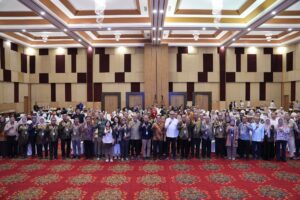
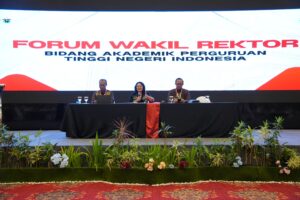
MAKASSAR – Hasanuddin University (Unhas) hosted the 2026 National Forum of Vice Rectors for Academic Affairs, bringing together university leaders to discuss the transformation of academic governance. Themed “Transformation of Higher Education Academic Governance: Strengthening Student Success, Student Admission Governance, Graduate Competencies, and Selection Integrity,” the forum took place at the Unhas Hotel Ballroom on Thursday (17 September), starting at 09:30 WITA (Central Indonesia Time).
The forum discussed a number of strategic issues in university academic management, particularly at state universities. The discussions covered four main agenda items: the Educational Efficiency Rate (AEE) and student success; the proportion of intake capacity for national merit-based admission (SNBP), national test-based admission (SNBT), and independent admission (Seleksi Mandiri); assessment weighting and graduate competency standards; and the prevention and mitigation of cheating in the student selection process.
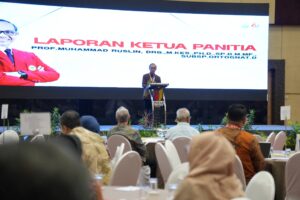
Organizing committee chair Prof. Muhammad Ruslin, drg., M.Kes., Ph.D., Sp.B.M.Mf., Subsp.Ortognat.D., who is also Unhas Vice Rector for Academic and Student Affairs, explained in his report that the forum was designed to bring together the experiences and perspectives of universities in responding to various academic management challenges. This exchange of experiences is expected to identify good practices relevant for joint development.
“We designed this forum to strengthen communication and consolidation among university leaders, particularly in responding to the dynamics of academic management. The various issues discussed are expected to enrich each university’s perspective in formulating and developing academic policies,” said Prof. Ruslin.
Prof. Ruslin said 75 universities had registered as forum participants. By the time the event was held, 46 universities were recorded in attendance, taking part in the series of discussions and sharing experiences on academic management at their respective institutions.
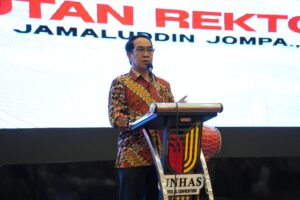
The event was officially opened by Unhas Rector Prof. Dr. Ir. Jamaluddin Jompa, M.Sc. In his remarks, Prof. JJ stressed the importance of data-based and outcome-oriented academic policymaking amid demographic and institutional transitions in higher education. According to him, the forum needed to look at academic governance as a whole, from student intake to graduate quality.
“Amid these demographic and institutional transitions, universities are required to formulate policies that are data-driven and outcome-oriented. This forum must become a space for policy calibration to evaluate four fundamental frameworks, namely new student admission (PMB) input, academic processes, research outputs, and graduate quality,” said Prof. JJ.
He expressed hope that the forum would produce a policy brief and concrete analytical recommendations. These are expected to be submitted to the Ministry of Higher Education, Science, and Technology (Kemdiktisaintek) as a basis for developing future policies and technical regulations.
In addition to the four main agenda items, the forum also highlighted the importance of aligning academic education with the business and industrial sectors (DUDI). The issue relates to the need to strengthen the relevance of graduate competencies to labor market needs, including by mitigating competency gaps and developing curricula jointly with industry.
Through the forum, universities are expected to build a shared understanding of the direction of academic governance transformation while strengthening the exchange of good practices to support student academic success, input quality, graduate competencies, and the integrity of the selection process.
Following the opening, the first day continued with group discussions on the four main issues. The forum runs until Saturday (19 September). On Friday (18 September), the agenda will continue with presentations of the results of focus group discussions (FGDs) on AEE and Student Success, intake capacity proportions, graduate competencies, and PMB selection integrity, which will then be formulated into national recommendations for strengthening academic governance in higher education.
The universities in attendance were:
1. Universitas Indonesia
2. Institut Pertanian Bogor
3. Universitas Negeri Jakarta
4. Universitas Pendidikan Indonesia
5. Universitas Sebelas Maret
6. Institut Teknologi Sepuluh Nopember
7. Universitas Trunojoyo Madura
8. UPN Veteran Jawa Timur
9. Universitas Palangkaraya
10. Universitas Diponegoro
11. Universitas Negeri Semarang
12. UPN Veteran Jakarta
13. Universitas Negeri Yogyakarta
14. Universitas Jember
15. Universitas Brawijaya
16. Universitas Jenderal Soedirman
17. Universitas Tidar
18. Universitas Malikussaleh
19. ISBI Aceh
20. Universitas Negeri Medan
21. Universitas Maritim Raja Ali Haji
22. ISI Padang Panjang
23. ISI Surakarta
24. Universitas Jambi
25. Universitas Bengkulu
26. Universitas Sriwijaya
27. Universitas Bangka Belitung
28. Universitas Sultan Ageng Tirtayasa
29. Universitas Singaperbangsa Karawang
30. Universitas Lambung Mangkurat
31. Institut Teknologi Kalimantan
32. Universitas Borneo Tarakan
33. Universitas Udayana
34. Universitas Mataram
35. Universitas Nusa Cendana
36. Universitas Timor
37. Universitas Negeri Makassar
38. Institut Teknologi BJ. Habibie
39. Universitas Sam Ratulangi
40. Universitas Tadulako
41. Universitas Haluoleo
42. Universitas Sembilan Belas November Kolaka
43. Universitas Pattimura
44. Universitas Khairun
45. Universitas Musamus Merauke
46. ISBI Tanah Papua
(*/mir)
Editor: Ishaq Rahman
This article is an English translation of the original Indonesian report.