
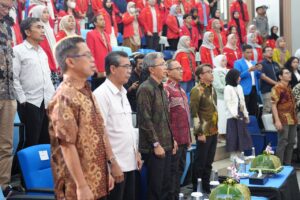
As a sign of its readiness to host, Hasanuddin University (Unhas) officially launched the mascot and logo of the 38th National Student Scientific Week (PIMNAS). The event began at 14:00 WITA (Central Indonesia Time) at the Arsyad Rasjid Lecture Theater, Unhas Tamalanrea Campus, Makassar, on Friday (11 July).
The event was attended by the Vice Rector for Academic and Student Affairs, Prof. drg. Muhammad Ruslin, M.Kes., Ph.D., Sp.BM(K); Prof. apt. I Ketut Adnyana, M.Si., Ph.D. (Director of Research and Community Service), representing the Ministry of Higher Education, Science, and Technology (Kemdiktisaintek); the Chair of the Unhas Academic Senate and members of the senate; deans; students; and invited guests from universities in Makassar.
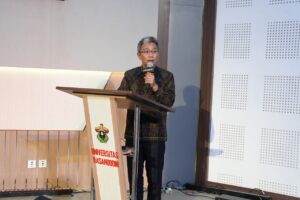
In a report, Prof. Ruslin, who is also the chair of the 38th PIMNAS organizing committee, said that the launch of the mascot and logo was the first step, driven by great enthusiasm, in welcoming the prestigious scientific event. Unhas has made various preparations to give the participants its very best.
“What we have been looking forward to most is the opportunity for Unhas to host PIMNAS. Today we are taking that first step with the launch of the official logo and mascot. It is a symbol of the burning spirit of Unhas to keep guiding students toward their best achievements,” Prof. Ruslin explained.
Unhas has prepared itself as well as it possibly can. Intensive discussions have continued, and the university leadership has made it clear that there will be no efficiency measures affecting student activities. Instead, the focus is on how to make the most of all the students’ potential and abilities.
This year, Unhas became the university with the highest number of Student Creativity Program (PKM) proposals while also receiving the largest amount of PKM funding nationally. This is proof of the very high enthusiasm and quality of Unhas students. Prof. Ruslin hopes this is a good sign that Unhas will be able to defend its champion title and retain the Adikarta Cup.
“This spirit comes not only from the leadership but also from our students, who have extraordinary commitment and capacity. The number of proposals successfully submitted and funded is clear proof of their enthusiasm and hard work. We hope this event can spark enthusiasm, not only as a visual symbol but also as a reflection of our shared determination to successfully host the 38th PIMNAS and defend our champion title,” Prof. Ruslin added.
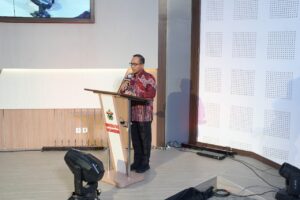
On the same occasion, Prof. I Ketut Adnyana, in an address, conveyed appreciation and full support for the hosting of the 38th PIMNAS at Unhas. Prof. Adnyana praised the achievements of Unhas and stressed the importance of research and innovation for national progress. Prof. Adnyana emphasized that a nation that prioritizes research and innovation will have a strong foundation for achieving prosperity and global competitiveness.
“We should be grateful that the budget for activities like this has not been subject to cuts. The government continues to fully support learning and the activities that form the foundation for national progress. Golden Indonesia 2045 is within sight, and students are at the forefront. I am confident that out-of-the-box ideas with great impact will emerge from PIMNAS,” Prof. Adnyana explained.
Closing the address, Prof. Adnyana thanked the Rector of Unhas and the entire leadership team, especially the chair of the organizing committee, for their hard work and dedication in preparing the event. Prof. Adnyana expressed hope that the 38th PIMNAS at Unhas would run smoothly and become one of the best-run editions in the history of PIMNAS.
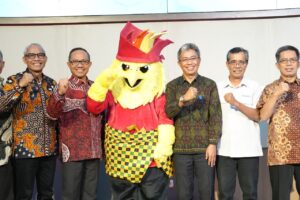
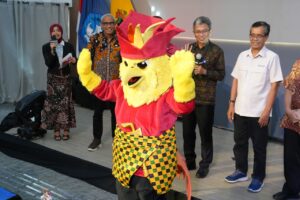
With the launch of the official mascot and logo, Unhas has marked the start of a strong commitment to delivering a prestigious scientific event that focuses not only on competition but also on developing ideas, innovation and collaboration among students from across Indonesia.
About the 38th PIMNAS Mascot
This year, the mascot has been named “To Panrita” and takes the form of a rooster. The PIMNAS logo, meanwhile, contains elements with the following meanings:
1. The Mandala Monument, an important symbol in the history of Indonesia’s struggle, particularly the 1962 operation to liberate West Irian. In PIMNAS, it represents the spirit of struggle and nationalism, and the champion spirit of students in developing science and technology to free their nation from lagging behind;
2. The Tongkonan house, symbolizing kinship and collaboration among participating teams. PIMNAS is not just a competition but a forum for exchanging ideas and building networks among students from various universities;
3. A pencil bearing the word Lagaligo, as a symbol of knowledge and creativity. Lagaligo is the world’s longest literary epic, from South Sulawesi, with I Lagaligo as its main character; it underlines the local cultural roots of every science-based innovation.
4. The Phinisi ship, representing the spirit of the Bugis-Makassar seafarers as master explorers. In the context of PIMNAS, the ship depicts the role of students as captains steering Indonesian innovation toward a prosperous maritime-continent society.
5. The Passapu, a traditional Makassar headdress symbolizing grandeur, local wisdom and the mental readiness of participants to channel their ideas into an impact on national progress;
6. The Maros-Pangkep Geopark, home to the world’s oldest prehistoric paintings.
7. A handshake, symbolizing that PIMNAS is not merely a competition but a space for synergy across various backgrounds and disciplines for a better Indonesia;
8. Lippa Sabbe, a silk sarong with intricate woven patterns, reminding participants that the PKM process requires precision and patience, just like weaving threads into a masterpiece.(*/mir)
Editor: Ishaq Rahman
This article is an English translation of the original Indonesian report.