
Hasanuddin University (UNHAS) continues to strengthen its commitment to supporting scholarship recipients throughout their academic journey, from gaining access to higher education to completing their studies. In 2025, 1,115 of 1,690 scholarship recipients from the 2021 cohort graduated, representing an overall completion rate of approximately 66%.
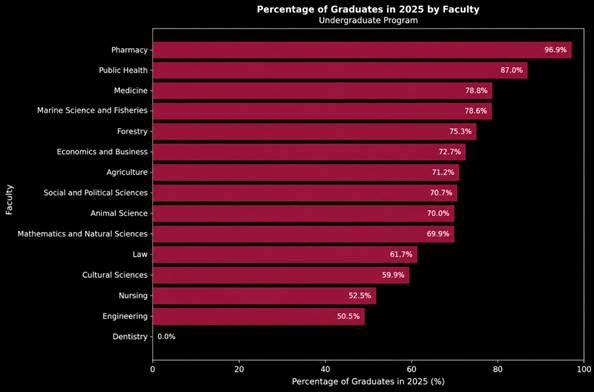
The figure provides UNHAS with an important reference for monitoring student progression and evaluating the academic and financial support available to scholarship recipients. Rather than viewing graduation rates merely as institutional statistics, the university uses the data to identify patterns of student progress and areas where more targeted support may be needed.
At the undergraduate level, graduation outcomes varied across faculties. Several faculties recorded completion rates above 70%, with Pharmacy leading at 96.9%, followed by Public Health at 87%. Medicine, Marine Science and Fisheries, Forestry, Economics and Business, Agriculture, Social and Political Sciences, and Animal Science also recorded relatively strong graduation outcomes.
Other faculties showed graduation rates ranging from approximately 50% to 70%. These differences provide useful information for the university in identifying where academic monitoring, advising, and support for students approaching the end of their study period may need to be strengthened.
The scholarship data also show that KIP-Kuliah remains the dominant scholarship scheme among the undergraduate students included in the dataset. A total of 1,610 students, or 98.35%, were supported through KIP-Kuliah, while the remaining recipients were distributed across several other schemes, including scholarships from the East Luwu Regional Government, KIP-K Yayasan Profesi, Yayasan Amal Bakti Da’sad Latif, Erlangga Scholarship, and the Afirmasi-ADIK program.
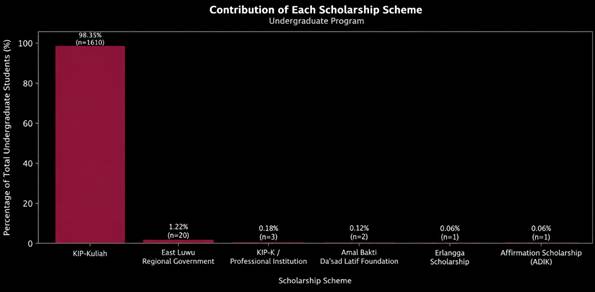
The strong representation of KIP-Kuliah highlights the program’s important role in expanding access to higher education at UNHAS. At the same time, the university recognizes that access alone is not sufficient. Scholarship recipients also need sustained academic support to remain on track, complete remaining credits and final projects, and graduate within the expected study period.
From Access to Completion
For UNHAS, scholarship policy is therefore closely connected to student retention, academic progression, and graduation. The 2025 data offer a basis for identifying faculties and groups of students that may benefit from more focused academic assistance.
Faculty-level and scholarship-level mapping can support earlier identification of students who are approaching the expected completion period but have not yet graduated. This can be followed by stronger academic advising, closer monitoring of study progress, identification of remaining academic requirements, and improved coordination among study programs, faculties, and scholarship administrators.
Such an approach is particularly important because students supported through different scholarship schemes may face different academic, financial, and administrative circumstances. More detailed mapping allows the university to develop support measures that respond more closely to students’ actual needs. With approximately 66% of the 2021 scholarship cohort having graduated by 2025, UNHAS will continue to strengthen its monitoring and assistance for students who are still completing their studies. The university’s commitment extends beyond opening access to higher education through scholarships; it also includes ensuring that students receive the support necessary to progress academically, overcome barriers to completion, and successfully earn their degrees.