
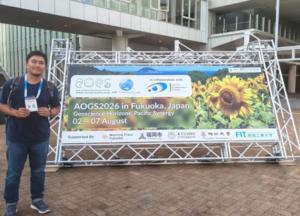
Saaduddin, Ph.D., a lecturer at the Department of Geophysics, Faculty of Mathematics and Natural Sciences (FMIPA), Hasanuddin University (UNHAS) participated in the Asia Oceania Geosciences Society (AOGS) Annual Meeting 2026, held at the Fukuoka International Congress Center, Fukuoka, Japan, from 2-7 August 2026. At the international conference, Saaduddin delivered an oral presentation entitled “Hazard Potential of Pyroclastic Density Current-Induced Tsunamis at Mt. Awu, Sangihe Islands” in the Interdisciplinary Geosciences session. During the 15-minute presentation, he discussed the potential for volcanic tsunamis generated by dense Pyroclastic Density Currents (PDCs) from Mt. Awu in the Sangihe Islands, North Sulawesi, Indonesia.
Volcanic tsunamis can be generated when dense PDCs rapidly enter the sea and displace large volumes of seawater. Mt. Awu represents an important case for investigating this mechanism due to its historical record of volcanic activity associated with tsunami events. Historical eruptions of Mt. Awu in 1856 and 1892 were associated with tsunamis, highlighting the importance of assessing the potential hazards posed by future eruptions, particularly to coastal communities across the Sangihe Islands. The study investigates the generation and propagation of PDC-induced tsunamis using two numerical models, FLUIDITY and COMCOT. The modeling approach aims to improve understanding of tsunami generation mechanisms and the subsequent propagation of waves toward surrounding coastal areas.
Saaduddin noted that participating in an international scientific forum such as AOGS provides an important opportunity not only to disseminate research findings but also to receive constructive feedback from the international geoscience community. He added that international scientific exchange is particularly valuable for volcanic tsunami research, as understanding these events requires interdisciplinary perspectives that connect volcanic processes, numerical modeling, ocean dynamics, and disaster risk reduction. The AOGS Annual Meeting brings together researchers and academics from various fields of geosciences to share recent scientific developments, exchange ideas, and establish international research networks. Participation in the meeting also provides opportunities for researchers to explore interdisciplinary approaches to addressing complex Earth and environmental challenges.
This scientific initiative directly aligns with several United Nations Sustainable Development Goals (SDGs). By advancing hazard assessment and disaster risk reduction for vulnerable coastal communities, the research supports SDG 11: Sustainable Cities and Communities and SDG 13: Climate Action. The international dissemination of research and scientific collaboration advance SDG 4: Quality Education by elevating global academic standards, while the interdisciplinary engagement within the international geoscience community embodies SDG 17: Partnerships for the Goals.