
MAKASSAR — The development of artificial intelligence and digital technology continues to bring change to the world of health. Not only in patient care, but also in how medical decisions and hospital management are made more accurately and on the basis of data.
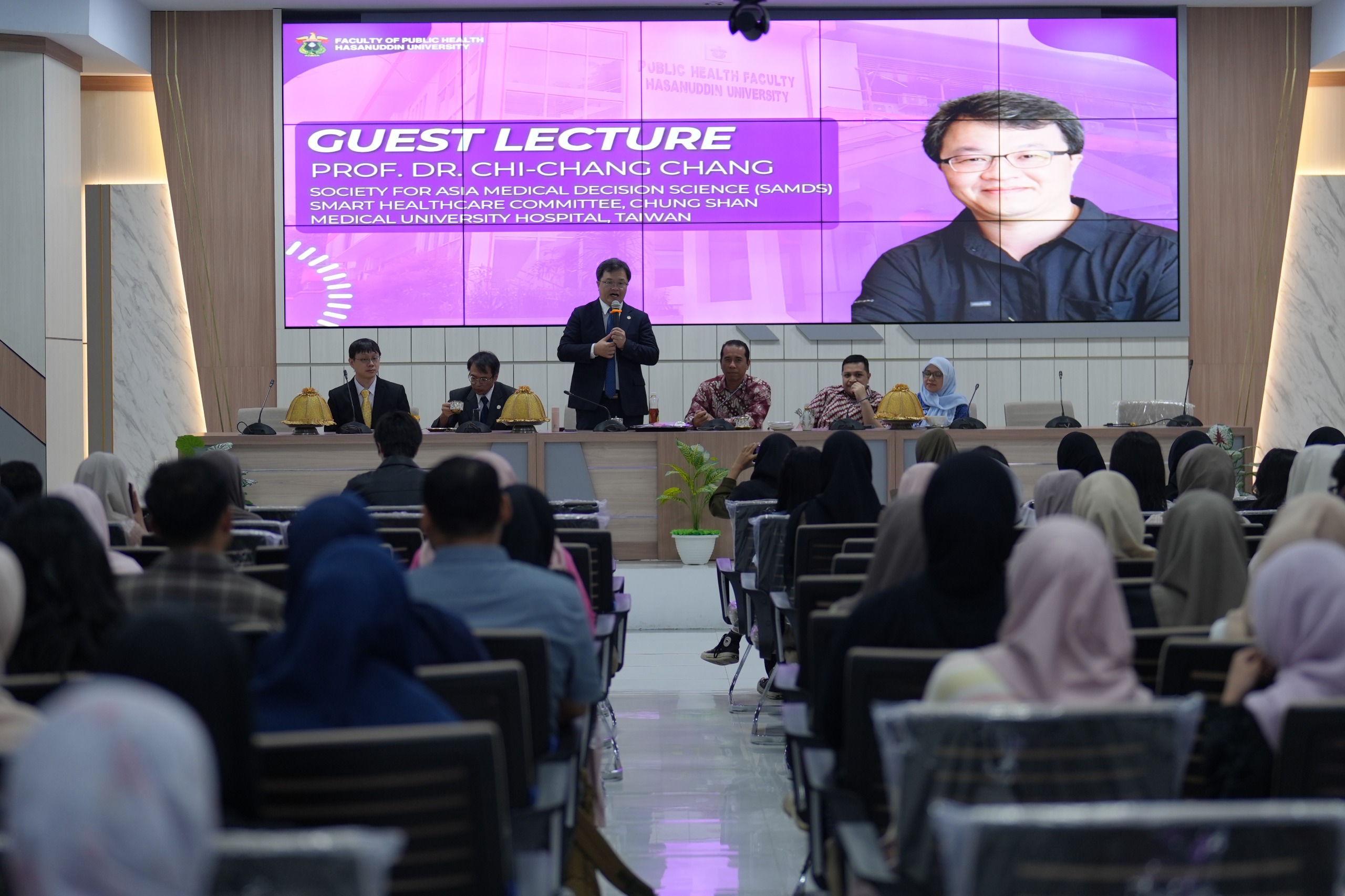
In light of these developments, the Hospital Administration Study Program of the Faculty of Public Health, Hasanuddin University, hosted an international guest lecture titled “Frontiers of Medical Decision Science: Research Trends in Digital Twins and World Models” on Wednesday, 26 August 2026.
The event, held at FKM Unhas, featured Prof. Dr. Chi-Chang Chang of the School of Medical Informatics, Chung Shan Medical University, Taiwan. Prof. Chang is also President of the Society for Asia Medical Decision Science (SAMDS).
Prof. Chang was not alone; the discussion also featured Prof. Hsi-Chieh Lee of National Quemoy University, Associate Prof. Ting-Ying Chien of Yuan Ze University, and Mr. Heng-Jui Liu.
Dean of FKM Hasanuddin University, Ansariadi, SKM., M.Sc.PH., Ph.D., said in the remarks that the presence of academics from these various institutions is part of the Master of Hospital Administration (MARS) FKM Unhas’s effort to broaden the insight of students and the academic community into the latest developments in health decision-making.
“This will certainly be an opportunity for us to pursue various forms of cooperation with universities in Taiwan. It also makes it easier for us to adapt scientific developments that we will realize in developing our study programs,” said Ansariadi.
President of the Society for Asia Medical Decision Science (SAMDS) and the Smart Healthcare Committee, Chung Shan Medical University Hospital, Taiwan. Prof. Dr. Chi-Chang Chang, in the public lecture, discussed medical decision science, particularly the use of digital twins and world models. The technology opens opportunities to analyze and simulate various conditions before a decision is applied in a real situation. This approach is becoming increasingly relevant amid the growing use of health data, artificial intelligence, and digital technology in health services.
“The development of digital twins and world models opens new opportunities in medical decision science. This technology allows us to understand various possible health conditions through simulation and data-based analysis, so that decisions can be made in a more measured and appropriate way.” Prof. Chang said
Prof. Chi-Chang further said that technological progress also brings challenges. In Prof. Chang’s view, using digital technology in health cannot rely on system sophistication alone.
Data quality, model validity, information security, ethical aspects, and even organizational and human resource readiness are important factors for the technology to truly benefit health services.
For Hospital Administration students at FKM Unhas, this forum is a space to view digital health transformation from a broader perspective. It is not only about technology, but also about how that technology can support services, management, and decision-making in hospitals.
Through this guest lecture, Hospital Administration at FKM Unhas also strengthens its academic atmosphere while opening space for developing international networks and collaboration.
Going forward, developments in medical decision science, smart healthcare, and digital health transformation are expected to become an important part of building a health service system that is increasingly adaptive, data-driven, and able to meet future needs. (*/ams)
Editor : Ishaq Rahman

This article is an English translation of the original Indonesian report.