
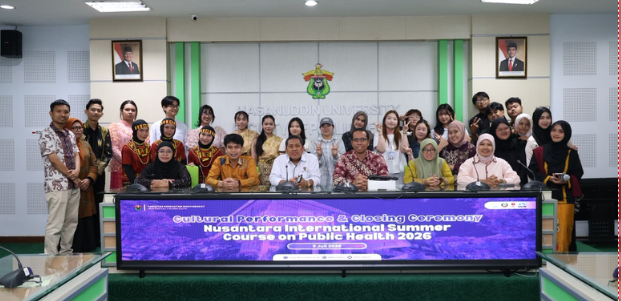
The Faculty of Public Health (FKM), Hasanuddin University (UNHAS), successfully organized the Nusantara International Summer Course on Public Health (NISC-PH) 2026, reaffirming its commitment to advancing internationalization, global public health education, and cross-cultural collaboration. Conducted through a hybrid learning approach, the program began with online academic sessions from 15–24 June 2026, followed by offline activities from 28 June–11 July 2026 in Makassar, Soppeng Regency, and Samalona Island, South Sulawesi.
One of the highlights of the offline program was the visit to Soppeng Regency, where international participants received a warm welcome from the Regent of Soppeng. The reception reflected the strong partnership between local government and higher education institutions in promoting global academic engagement and community-based learning. Participants from Mahidol University (Thailand), Soonchunhyang University (South Korea), international students studying at FKM UNHAS, and UNHAS students explored local communities, public health practices, and the rich cultural heritage of South Sulawesi. Through field visits and cultural immersion activities, participants gained firsthand experience of community-based public health approaches while strengthening their intercultural understanding.
Throughout the two-week program, participants engaged in a wide range of academic and experiential learning activities, including expert lectures, public health discussions, institutional visits, community engagement, and cultural exchange. These activities provided valuable insights into Indonesia’s public health system while fostering international networking and collaboration among students and academics from diverse backgrounds. The integration of classroom learning with field experiences enabled participants to better understand the relationship between public health, culture, and sustainable community development.
The program officially concluded with a Closing Ceremony held in Makassar, attended by participants, lecturers, facilitators, organizing committee members, and supporting staff. During the ceremony, Prof. Sukri Palutturi, SKM., M.Kes., MSc.PH., Ph.D., Dean of the Faculty of Public Health, UNHAS, expressed his appreciation to all partners and participants for their dedication throughout the program. He emphasized that NISC-PH serves as an important platform for developing scientific competence, global perspectives, and cross-cultural collaboration among future public health professionals. The ceremony also featured cultural performances that celebrated the diversity, friendship, and meaningful connections established during the program.
The successful implementation of NISC-PH 2026 reflects FKM UNHAS’s continuous commitment to strengthening international academic partnerships and producing globally competent public health professionals. By integrating academic excellence, cultural exchange, and community engagement, the program contributes to the achievement of the Sustainable Development Goals (SDGs), particularly in promoting Quality Education (SDG 4), Good Health and Well-being (SDG 3), and Partnerships for the Goals (SDG 17), while further enhancing UNHAS’s reputation as an internationally engaged institution in public health education.