
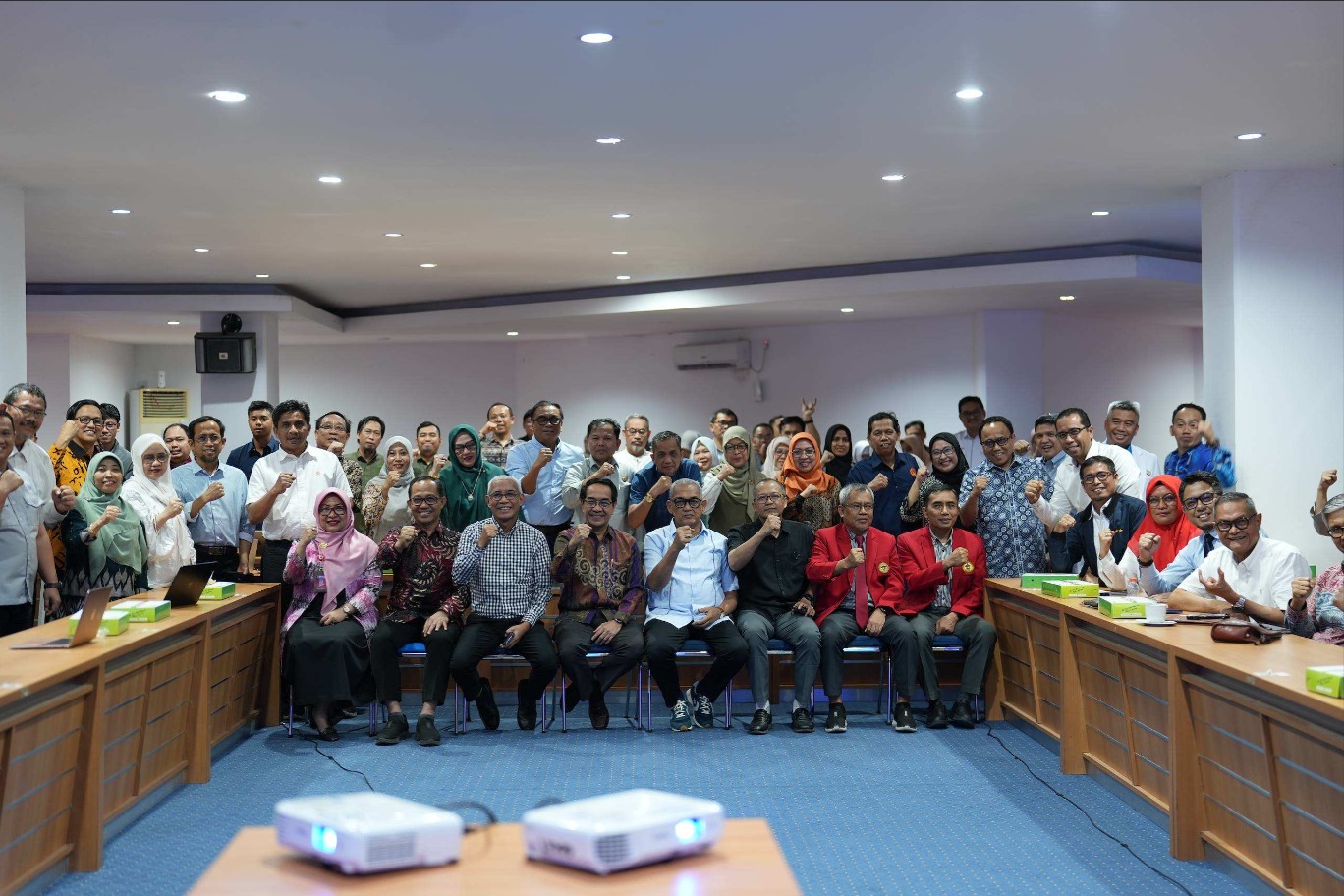
*MAKASSAR* —Ahead of preparations for the 2028–2032 accreditation period, Hasanuddin University (Unhas) is strengthening its quality assurance system by ensuring that every performance indicator of its study programs and faculties is supported by valid and accountable data.
The step comes as Unhas’s current accreditation nears its expiry in December 2027. Early preparation is needed because the accreditation process involves a series of steps: data collection, evaluation, document preparation, and substantiation of the institution’s performance achievements. Accreditation readiness cannot be built when the validity period is nearing its end; it is part of a quality assurance process that runs continuously.
Unhas Rector Prof. Dr. Ir. Jamaluddin Jompa, M.Sc, stressed the importance of ensuring that all study programs are prepared to manage the validity periods of their accreditation. Monitoring is carried out regularly as part of the quality control system so that the accreditation process can be prepared on time.
“We always monitor the validity period of accreditation. We send reminders to the deans, to be passed on to the study programs, so that no accreditation process is missed,” Prof. JJ explained.
Within the quality assurance framework, one important aspect of the accreditation process is data that is valid and verifiable. Prof. JJ said that every reported performance indicator needs relevant supporting evidence, so that accreditation documents can describe the institution’s condition administratively while also showing its achievements and its process of quality improvement.
The Head of the Institute for Quality Assurance and Educational Development (LPMPP) at Unhas, Prof. Rini Rachmawaty, S.Kep., Ns., MN., Ph.D., explained that the university’s and study programs’ planning documents must serve a function that goes beyond merely meeting administrative requirements.
According to Prof. Rini, the strategic plan needs to show a development direction that is clear, measurable, and open to evaluation. This covers the main areas of higher education, from education and research to community service.
“Strengthening quality also covers aspects that directly touch the educational process, such as the availability and competence of lecturers, the lecturer-to-student ratio, facilities and infrastructure, laboratories, the learning process, and educational outcomes. All these components are interrelated and need to be managed in an integrated way by faculties and study programs,” Prof. Rini explained.
In this context, Prof. Rini said, accreditation can be seen as a mirror showing the consistency between what the institution plans, what it carries out, and what it produces. The stronger the connection among these three aspects, the stronger the institution’s basis for demonstrating its performance and the sustainability of its quality.
Prof. Rini said the various challenges in the accreditation process need to be addressed through cross-unit collaboration. Unhas’s status as a legal-entity state university (PTNBH) gives the university room to develop policies and management strategies that are more adaptive to the institution’s needs.
“A collaborative approach is an important part, because achieving Superior Accredited status does not depend on a single work unit. The institution’s performance is the accumulation of processes taking place across many fronts, including study programs, as the units that directly deliver education and produce graduates,” Prof. Rini explained.
Therefore, preparations for 2028–2032 superior accreditation are directed at strengthening a system that can produce data consistently, document processes well, and use measurement results as a basis for decision-making. With this approach, accreditation data does not remain an archive but becomes a source of information for reading performance and determining the institution’s development direction.
These efforts were discussed at the Kick Off for the Preparation of Higher Education Accreditation Documents to Obtain Superior Accredited Status, organized by LPMPP Unhas as a first step in aligning understanding and strengthening coordination among all leadership elements in facing the accreditation process. The event took place in the LPMPP Unhas Hall on Wednesday (12 August). (*/cal/mir)
Editor: Ishaq Rahman

This article is an English translation of the original Indonesian report.