
PANGKEP – Indonesia’s small islands hold abundant marine wealth. Yet this potential does not always translate into prosperity for communities. Much of the seafood is still sold as a raw commodity or consumed only within households, so its economic value has not developed fully. At the same time, the local culture that forms the identity of island communities also faces the challenge of staying alive as the tourism sector grows.
These problems show that developing coastal areas cannot rely on natural resources alone. What is needed is the ability to turn local potential into value-added products, while making culture a strength in building sustainable tourist destinations. In this process, women play a strategic role as drivers of the family economy and guardians of community traditions.
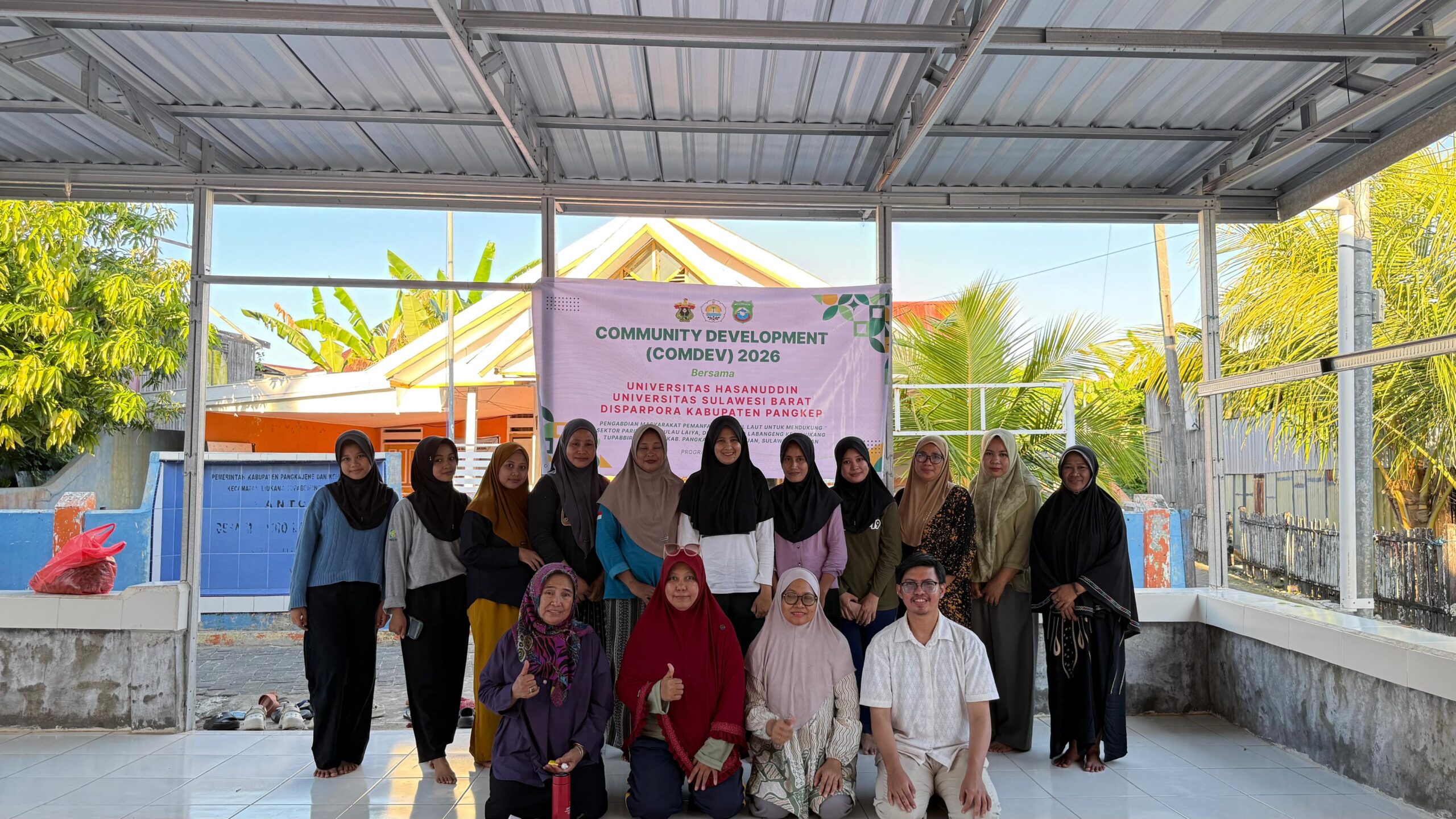
Seeing both the potential and the challenges, a team of Hasanuddin University lecturers developed a community empowerment program that integrates cultural security diplomacy with educational tourism on Laiya Island, Mattiro Labangeng Village, North Liukang Tupabbiring District, Pangkajene and Islands Regency.
The program is funded by the Indonesia Endowment Fund for Education (LPDP) through the 2026 Community Development (ComDev) scheme as an effort to strengthen women’s capacity to develop businesses based on seafood and tourism.
Before drawing up the program, the Unhas team first held discussions with the village government and women’s groups to map the community’s needs. This approach was an important step so that the solutions offered would not be merely academic, but would genuinely address the challenges island communities face in developing their local economic potential.
The Community Service Team Leader, Prof. Dr. Seniwati, S.Sos.,M.Hum., explained that developing small-island areas requires an approach that does not focus only on raising people’s incomes. Economic development must go hand in hand with preserving local culture so that communities gain economic benefits without losing the identity that is the main strength of a tourist destination.
“Through focus group discussions (FGDs), practical demonstrations, and direct mentoring, 15 women entrepreneurs received training in hygienic seafood processing, food preservation techniques, product packaging, and improving the quality of processed products so that they are more competitive,” said Prof. Seniwati.
The community service team provided raw materials as initial capital and trained participants in financial literacy, determining production costs and selling prices, and digital marketing. This approach is expected to widen the marketing of processed seafood products to reach tourists and consumers from various regions.
What sets this program apart from typical entrepreneurship training is the concept of education tourism combined with cultural security diplomacy. In this approach, tourism is seen not only as an economic activity but also as a learning space for introducing local cultural richness, coastal community traditions, and responsible practices in using marine resources. In this way, tourism development goes hand in hand with efforts to protect the cultural identity of the people of Laiya Island.
Solutions for island communities were developed through multidisciplinary collaboration that also involved Universitas Sulawesi Barat, students, the village government, and an international partner, the University of Ilorin, Nigeria. This synergy shows that development challenges on small islands require a combination of expertise, field experience, and cross-institutional partnership in order to produce lasting impact.
The program, carried out on 14 April 2026 and 15 June 2026, also contributes to achieving the Sustainable Development Goals (SDGs), especially SDG 1 (No Poverty) through strengthening women’s economic standing, SDG 4 (Quality Education) through building community capacity, SDG 14 (Life Below Water) through sustainable use of coastal resources, and SDG 17 (Partnerships for the Goals) through collaboration among various partners.(*/pngb/mir)
Editor: Ishaq Rahman
This article is an English translation of the original Indonesian report.