Hasanuddin University (UNHAS) continued to strengthen its commitment to expanding inclusive access to higher education through the Kartu Indonesia Pintar (KIP), or Indonesia Smart Card, Program in 2025. The program represents one of UNHAS’s key forms of support for students with academic potential who face financial barriers to pursuing higher education.
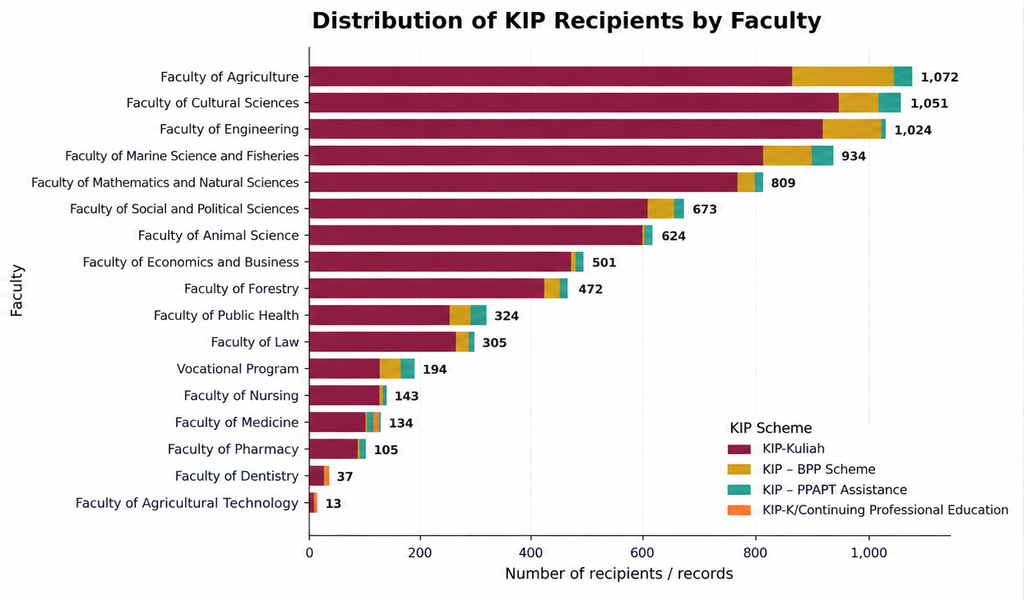
Based on 2025 data, there were 8,415 recipients or assistance records under the KIP Program across several schemes. This distribution demonstrates that KIP serves not only as financial assistance for education but also as an instrument to help ensure that economic circumstances do not prevent students from accessing quality higher education.
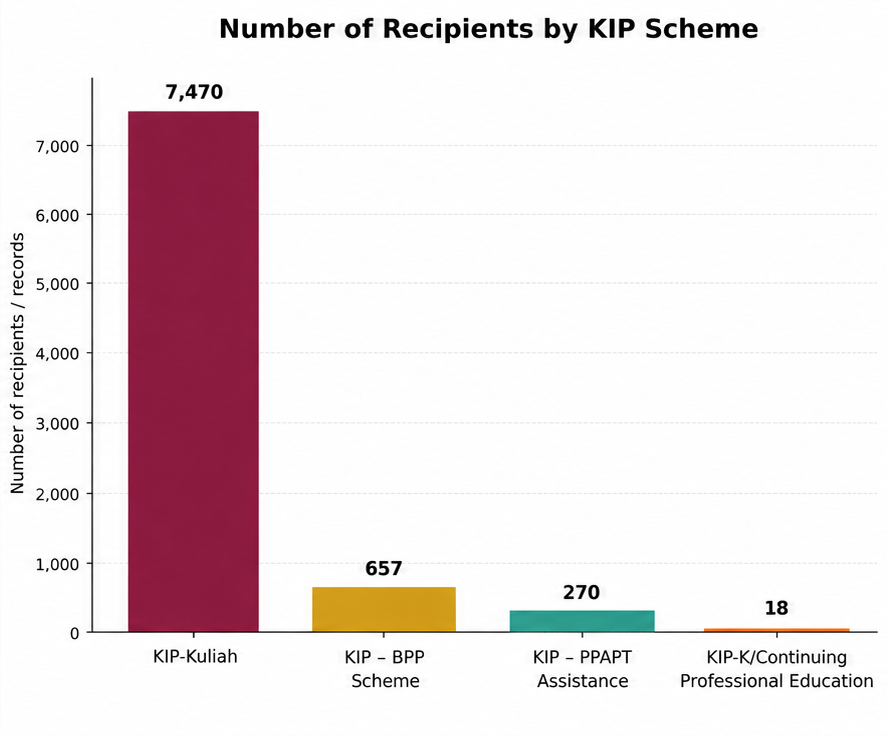
The largest scheme was KIP-Kuliah, with 7,470 recipients. This scheme serves as the primary form of educational support for undergraduate and vocational students who meet the program’s eligibility requirements. Through KIP-Kuliah, students are expected to be able to focus more fully on their academic studies, develop their potential and achievements, and complete their studies on time without being constrained by financial difficulties.
In addition to KIP-Kuliah, UNHAS provided assistance through the KIP – BPP Scheme, reaching 657 recipients. This scheme complements the financial support available to students in accordance with applicable provisions and recipients’ needs. Meanwhile, KIP – PPAPT Assistance reached 270 recipients, contributing to efforts to sustain educational support for students throughout their studies.
UNHAS also provided the KIP-K/Continuing Professional Education Scheme, with 18 recipients. The availability of this scheme reflects the university’s attention to continuity of educational access, including for students pursuing professional education in their respective fields.
Supporting Equal Opportunities
The KIP scholarship program is fundamentally designed to promote equal opportunities in accessing higher education. Through this program, students from economically disadvantaged families are provided with opportunities to enter university, pursue their studies, achieve academically, and complete their education at Hasanuddin University.
This commitment aligns with UNHAS’s role as a higher education institution that focuses not only on academic quality but also on equitable access to education. KIP is expected to serve as a pathway for students to develop their capabilities, enhance social mobility, and ultimately contribute to their communities, regions, and the nation.
Through the various assistance schemes available, UNHAS continues to optimize the implementation of the KIP Program so that the benefits of higher education can reach students who need financial support. The program also reinforces the principle that higher education should be broadly accessible and that financial limitations should not become a major barrier to pursuing a university education.