
Hasanuddin University (UNHAS) distributed Kartu Indonesia Pintar Kuliah (KIP-Kuliah), or the Indonesia Smart College Card Scholarship, to students across all faculties in 2025. This broad distribution reflects UNHAS’s commitment to expanding inclusive access to higher education by ensuring that support for high-achieving students from economically disadvantaged families reaches diverse academic disciplines and educational pathways.
Based on 2025 KIP-Kuliah recipient data, scholarship recipients were enrolled across 17 faculties, schools, and educational programs at UNHAS. The data show a total of 7,470 students, representing fields ranging from social sciences and humanities to science and technology, agriculture, marine sciences, health sciences, vocational education, and professional programs.
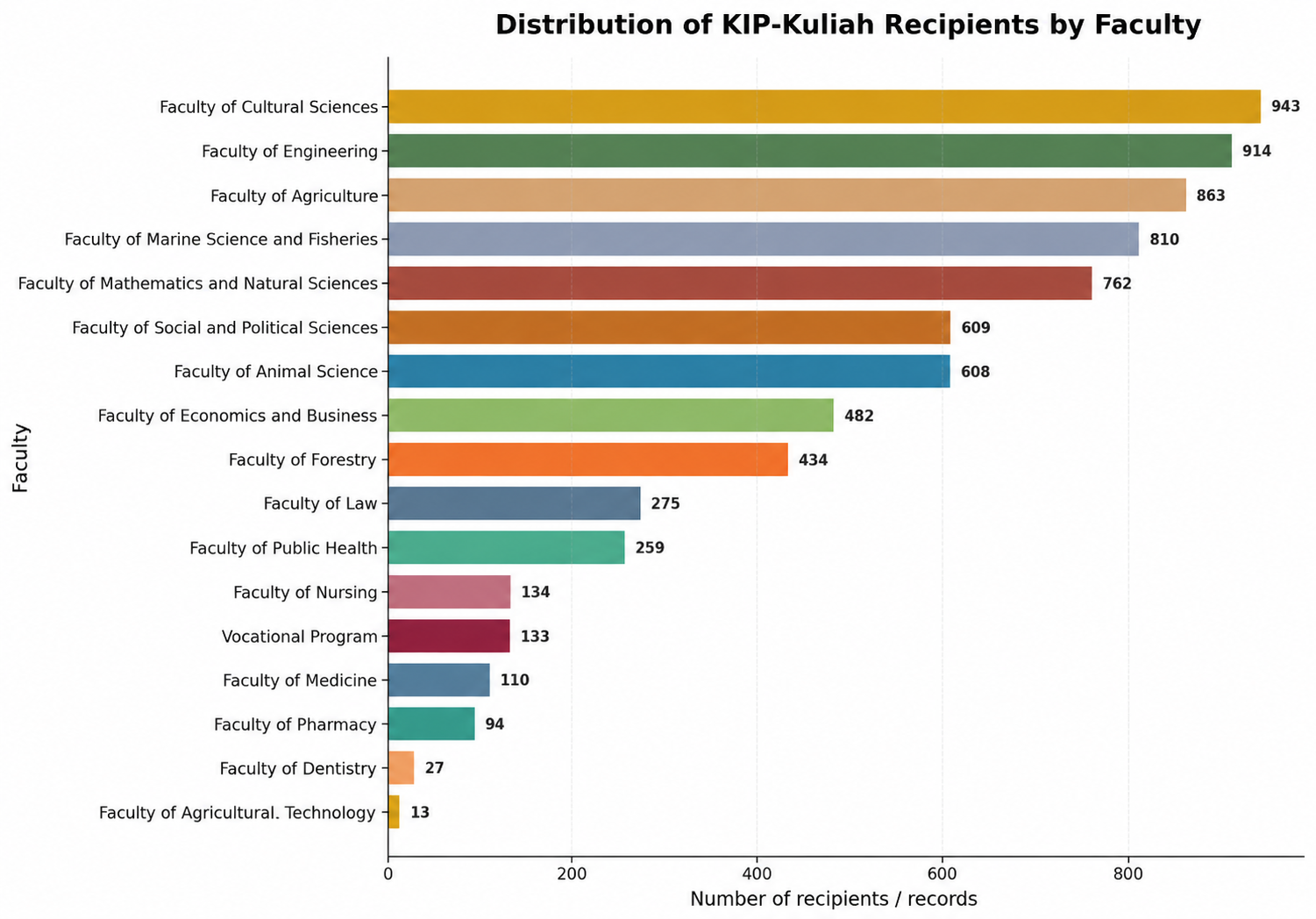
The Faculty of Cultural Sciences recorded the highest number of KIP-Kuliah recipients, with 943 students, followed by the Faculty of Engineering with 914 students and the Faculty of Agriculture with 863 students. Other faculties with substantial numbers of recipients included the Faculty of Marine Science and Fisheries with 810 students, the Faculty of Mathematics and Natural Sciences with 762 students, the Faculty of Social and Political Sciences with 609 students, and the Faculty of Animal Science with 608 students.
Recipients were also distributed across the Faculty of Economics and Business, with 482 students; the Faculty of Forestry, 434 students; the Faculty of Law, 275 students; and the Faculty of Public Health, 259 students. In health sciences, vocational education, and professional fields, recipients included 134 students from the Faculty of Nursing, 133 students from vocational programs, 110 students from the Faculty of Medicine, 94 students from the Faculty of Pharmacy, 27 students from the Faculty of Dentistry, and 13 students from the Faculty of Agricultural Technology.
Promoting Equal Educational Opportunities
The presence of KIP-Kuliah recipients across all faculties demonstrates that the program is not limited to particular fields of study. Students with strong academic potential who meet the program’s economic eligibility requirements have opportunities to receive educational support across the social sciences and humanities, sciences, engineering, agriculture, marine sciences, health sciences, and vocational education.
This broad distribution is important because the need for financial support in higher education exists across all academic disciplines. KIP-Kuliah therefore not only helps students finance their studies but also supports the development of diverse talents needed to contribute to various sectors of society and development.
In 2025, KIP-Kuliah at UNHAS was intended for high-achieving students from economically disadvantaged families, providing support for tuition fees as well as living expenses throughout their studies in accordance with the program’s provisions. By distributing this support across all faculties, UNHAS seeks to ensure that financial constraints do not become a major barrier for students to enter, pursue, and complete higher education.
KIP-Kuliah at UNHAS Since 2020
According to the archives of the UNHAS Directorate of Student Affairs, the university already had records of KIP-Kuliah recipients from the 2020 student intake, including students admitted through the UTBK pathway and the independent admission pathway in the first semester of the 2020/2021 academic year. This indicates that the KIP-Kuliah scheme has been implemented at UNHAS since at least 2020.
At the national level, KIP-Kuliah was launched in 2020 as a transformation of the Bidikmisi program, which had been implemented since 2010. The program was subsequently enhanced through the KIP Kuliah Merdeka scheme in 2021. Since its initial implementation, UNHAS has continued to facilitate the program as part of its efforts to make higher education more accessible, equitable, and opportunity-oriented for prospective students who meet the eligibility criteria.